Ring of Fire Nails: What They Really Mean
Like Nemo swimming through the Ring of Fire in “Finding Nemo,” many women unknowingly undergo an initiation of their own every time an electric nail file leaves painful grooves on their nails. But unlike the movie, this rite of passage isn't harmless. To understand why rings of fire have become so common—and why they should never be considered normal—we first need to look beneath the surface of the nail itself.
Table of Contents
What Causes the Ring of Fire
Modern Times, Modern Impatience
An Unexpected Consequence
You Are Free To Do Whatever You Like

A brittle and damaged nail with the ring of fire.
In the film, Finding Nemo, a young clownfish named Nemo living with his father on the edge of the Great Barrier Reef, is captured by a scuba diver who takes him as a prize for his office fish tank. In captivity, Nemo meets a crew of other fish who’ve mostly come from pet stores, all quite content to be in the tank. Well, almost all: the leader of the tank, a scarred Moorish idol originally caught in the wild named Gill, spends most of his days concocting elaborate plans for all of them to escape into the ocean. And it’s Gill who most enthusiastically welcomes Nemo to the Tank Gang through the “Ring of Fire” initiation ceremony, in which he is implored to swim through the bubbles of Mount Wannahockaloogie, a toy volcano that’s the centerpiece of the tank. Nemo, understandably scared at first, not knowing whether the bubbles would hurt him or not, nonetheless successfully swims through it, officially becoming a member of the family.
The “Ring of Fire,” of course, is also quite a familiar term to women who’ve made manicures a regular part of their life. In the context of nails, it describes visible marks left on the nail plate from electric nail drill use, that leaves the nail painfully thin, uneven, and produces a burning sensation.
It’s become so common for women to have rings of fire on their nails that one can say it’s like an initiation, much like the one in “Finding Nemo”–it connects all those who’ve partaken in the modern manicure, rushed and aesthetics-focused.
This article tries to address a problem that’s bothered us for years about common approaches that try to downplay rings of fire. The worst of these just claims that the ring of fire is a normal part of a manicure that will heal quickly and requires no concern, which is a complete fabrication, since they ignore the realities of the nail anatomy. (Imagine saying that searing pain, unevenness, and visible swelling anywhere on the body is “normal,” but here we are.) A better sort of resource offers a shift in perspective, a changed understanding from which different actions can follow.
What Causes the Ring of Fire
In the world of nails, that the electric nail drill is solely responsible for causing the ring of fire is not any kind of secret, being a fairly obvious position to those who actually take a moment to think about cause and effect. You can Google it, you can ask AI, you can talk to those around you who also suffer from rings of fire—any and all responses will point squarely at the electric nail drill.
And yet people continue to be told by nail professionals, influencers, and manufacturers who are personally motivated to continue the mass use of electric nail drills, that it’s all fine. When we Googled “ring of fire nails,” the AI Overview used several links that Google presented as its top search results for the keyword. One of these articles from a nail drill manufacturer had a section titled, “How to Prevent Rings of Fire on Nails,” with this sentence making their intentions plain as day, “While they may look alarming to clients, they are best understood as feedback on technique (using the electric nail file)...”
Although we’re all for nail technicians learning, the prospect of you enduring painful nails just for “feedback on technique” is a dubious proposition.
In any case, the truth and very open secret remains that electric nail files are the one and only cause of rings of fire on your nails. So why is everyone in the nail industry so fiercely protective and hellbent on continuing to use them?
Modern Times, Modern Impatience
Today, most manicures promise two things: that your nails will look “prettier” after the manicure than before, and that it’ll only take thirty minutes to do it. Few things are more appealing these days, than something you want also taking up as little time as possible in your busy day. But that allure can lead you astray.
While most clients assume that caring and doing what’s best for the health of the nails is a given, inherent in every nail service, they skip reading the fine print: the nail industry never makes such promises.
It’s not that nail salons and nail professionals don’t want to do what’s best for your nails, exactly. It’s just that it’s not possible to do in half an hour, along with all the other expectations. To make nails pleasing to the eye on the surface, and meeting the demand to hurry, all the while ensuring lasting nail health: many have tried to squeeze all three of these attributes into the time demands of modern clients, and all have failed. The reality of time is, and will always be, undefeated. To be human operating within this finitude of time is to commit to a choice, which necessarily excludes countless others.
So the nail industry made its choice, riding the waves of the 1970s and 1980s alongside the growing number of professional women in the workforce—doctors, financial managers, and lawyers. Efficiency and time management was now more important than ever, with the ubiquity of electric nail files a direct byproduct: it was an adaptation of rotary technology originally developed for dentistry and other technical industries, which allowed technicians to work more quickly on the thick acrylic enhancements that had become fashionable.
This modification, rather than developing an entirely new technology specifically for natural nail care, supercharged a shift in the economics of the manicure itself: from a slow, hand-crafted treatment toward a higher-throughput salon service. More appointments, more clients, greater consistency across technicians, at lower labor cost per service. The electric nail file solved the economic problem of time, and clients were now able to have pretty nails from unprecedentedly short appointments. It was a win-win.
An Unexpected Consequence
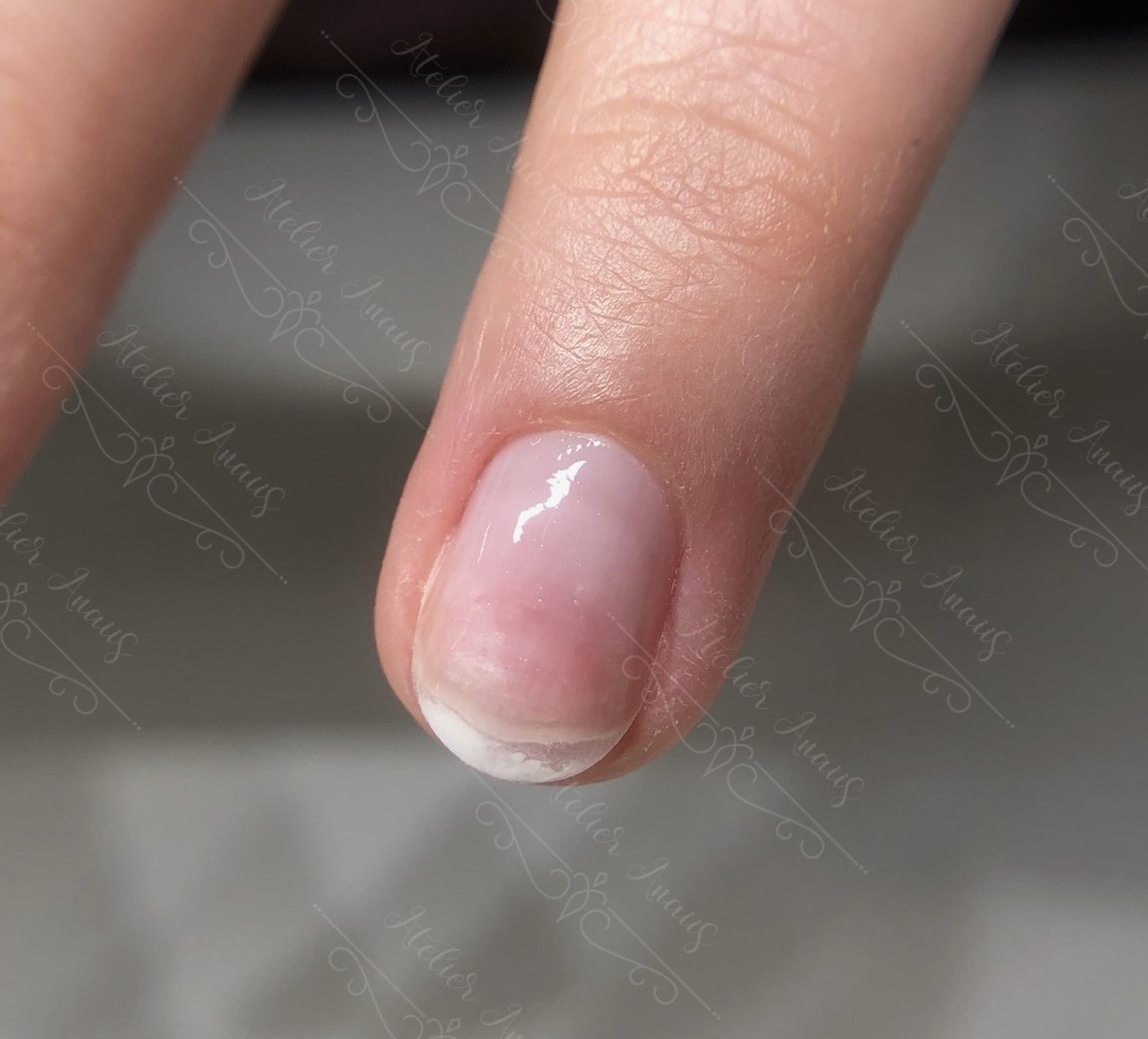
Ring of fire, appearing clear as day under a layer of base coat.
Except it turns out that it wasn’t a win-win at all. One of the unspoken–and quickly forgotten–rules of technological innovation is that side effects and consequences from its use only surface years later. By default, these are always unexpected and unpredictable, entering the collective consciousness as something worth discussing only once enough people have used it and there’s a growing mountain of evidence of negative consequences. While it’s difficult to put an exact number on how many cases are “enough,” we’re all familiar with the routine: not enough people counted as evidence and it’s dismissed as a one-off, everything carrying on as before.
As a surge of momentum gathered over the ensuing decades after the introduction of electric nail files, there was an explosion in the number of nail salons offering the same kinds of quick services. Proportionately, cases of rings of fire began to increase. It was a natural cause and effect relationship: just as heavy rains during the monsoon season lead to flooding, use of e-files led to rings of fire.
The main problem that we’ve learned, of adapting rotary technology originally developed for dentistry to use on our nails, is that our nails are made of completely different material than our teeth.
How different, you ask? Tooth enamel is mainly composed of hydroxyapatite, making it the hardest substance in the human body. It scores a five on the Mohs Hardness Scale, making it harder than steel, gold, and iron. Keratin, the primary material in our hair and nails, is certainly tough but is most remarkable for its flexibility thanks to its layered composition, and is rated at two on the Hardness Scale.
The difference can be imagined from the perspective of a craftsman shaping two objects: one carved from oak wood, the other from marble. Both can be refined, but not even beginners would assume the same tools are the natural starting point for each. Marble's hardness makes high-speed rotary cutting an obvious choice. Oak, being softer and fibrous, has traditionally been worked with hand planes, chisels, rasps, and sandpaper—tools that emphasize control over speed. Of course, that’s not to say that the craftsman absolutely cannot use the high-speed rotary for the oak wood. It’s just that if your goal is preserving a paper-thin veneer, the high powered tool has much less margin for error because it removes material so much faster.
In this way, while it’s true that modern e-files are designed with adjusted speeds and abrasive bits for what’s been deemed as “appropriate” for nail use, the question is not whether it can be used: the question is whether you–as the client–are willing to face the consequences of an abrasive drilling into your nails, rotating at thousands of revolutions per minute, in exchange for a manicure that will certainly save you time, but cannot possibly preserve your nail health.
To go back to an earlier point: Are you willing to endure searing pain to your nails at the slightest touch for “feedback on technique?”
You Are Free To Do Whatever You Like
At some point, as you tire of the daily experience of living with rings of fire on your nails, you may seek restorative nail care from a studio like Atelier Anaiis. There’s often a notion that rings of fire can be spot treated and healed, with some kind of magical product. It’s a wonderful wish. But unfortunately, no such product exists. Many people also assume a false symmetry between damage and recovery: if a single manicure with an e-file was enough to create rings of fire, surely it shouldn’t take much longer to heal them. But think of it like recovering from a broken leg: breaking it only takes a split second, but complete recovery takes months.
The truth, though it often makes people exasperated to hear it, is that it takes six months to three years to completely heal your nails from rings of fire, because the only way to rehabilitate them is for the parts of your nails with the damage to grow out and be clipped off. And that timeline, as long as it may seem, is still a light at the end of the tunnel compared to the alternative, possible only through all the considered treatment and protection that restorative nail care provides.
In the end, the staggering reality–in the words of Sheldon B. Kopp, a renowned psychotherapist–is that you’re free to do whatever you like. You need only face the consequences.
Going for the quick, thirty minute manicure that lets electric nail files be used on you necessarily means forgoing all considerations for nail health; deciding to forgo treatment for your rings of fire means dealing with the consequences of the decision to allow vulnerable nails to receive even more damage.
Whatever choice you make, we’ll all do well to remember that consequences are never optional.