Most nail damage attributed to gel doesn’t happen during application—it happens during removal. Understanding this changes how you approach nail care and what actually leads to strong, healthy nails.
Table of Contents
Why Most Gel Removal Damages Nails
The Journey Our Clients Take
What Proper Removal Looks Like
Where to Begin
Frequently Asked Questions
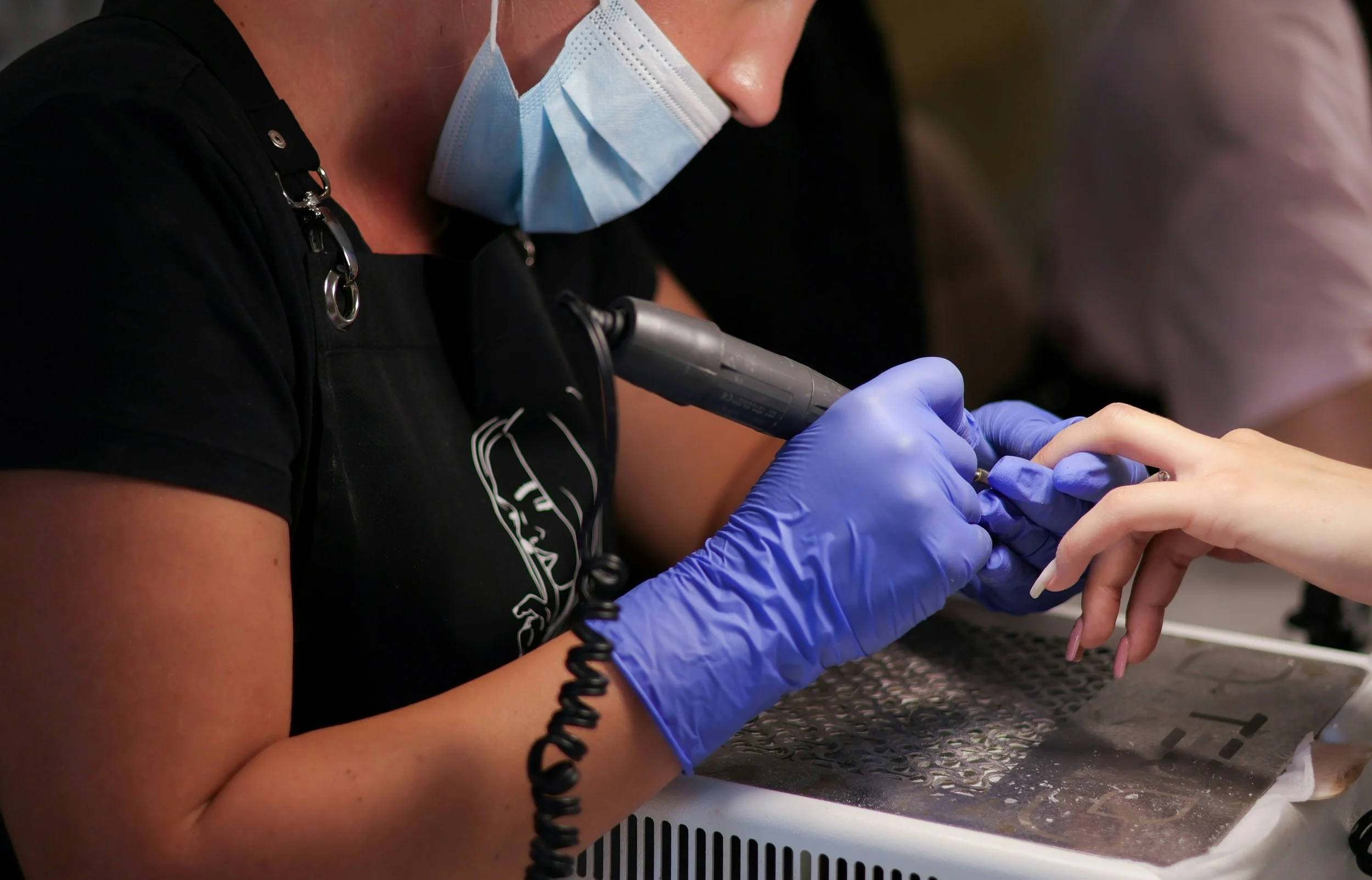
If this is what nail care currently looks like for you, keep reading.
There are many nail concerns that clients come to Atelier Anaiis with, but one of the most common is their previous experiences with product removal.
“My nails feel thin after gel removal.”
“They drilled too far down.”
“I have dents in my nails now.”
“They scraped too aggressively.”
“My nails feel damaged after removal.”
If you believe all gel removal is the same, you’re stuck between a rock and a hard place – you can’t protect your nails because you rightfully fear damaging gel removal methods. In turn, you feel forced to leave your nails bare without protection — something we don’t recommend.
There’s a healthier way to remove gel that prioritizes nail health. One that does not thin your nails or lead to breakage. Under the Atelier Anaiis model, removal becomes a focal point, not an annoyance for the nail tech to rush through.
But first, this requires a fundamental shift in mindset.
Why Most Gel Removal Damages Nails
When you think back to the professional manicures you’ve had, how many nail salons charged for soak off and gel removal? We’d bet not too many.
Providing this portion of a manicure for free has become standard practice for the nail industry.
But take a moment to think about what that’s really saying. Alarm bells should be going off inside your head.
Because what these salons are silently communicating to you by charging only for product application is:
“We know you’re here for aesthetic reasons, so that’s what we’re going to focus on.”
“Since we’re giving you product removal for free, we’re going to do it as fast and as cheaply as possible so we don’t lose money.”
“We have zero incentive to care about your nail health because you’re not paying us for that.”
These messages are physically expressed as:
Using electric nail drills to remove products, leaving a trail of destruction
Buffing the nail as fast and aggressively as possible
Soaking nails in acetone, the harshest and cheapest removal chemical
For any beauty service, you should be very cautious of anything free.
Think about it this way. If you were an employee at a company that expected you to take on additional work outside of the job description – at no additional pay – what would you do?
Even if you admirably take on the additional responsibility for a short while (because you’re hard-working, disciplined, and a great employee), eventually you’ll tire. You’ll begin looking for shortcuts or another job because, well, you’re not being paid to do the additional work.
Why would nail salons be any different?
So the mindset shift is this: A nail salon charging for gel removal is communicating that they’ve taken on the responsibility of doing so with your nail health in mind.
It means they’ve put their reputation on the line, because you – as the paying client – can now identify on the receipt that you’ve paid for the service to be delivered up to a certain standard.
This is how we approach product removal at Atelier Anaiis.
The Journey Our Clients Take
But why is gel so stubborn and difficult to remove in the first place?
Gel polish, once properly applied and cured, is amongst the toughest and most resilient products there is. This is not a secret to anyone in the nail industry. That’s why it serves as the foundation of our Protective Manicure system.
But there are always two sides to a coin. And the flip side of gel’s toughness is its difficulty to remove.
Unfortunately, the fact that the nail plate is fairly delicate to begin with, combined with the industry norm of rushed appointments, gel manicures – and more precisely the removal of gel – has been at the center of a surge in cases of nail damage.
This is where Atelier Anaiis comes in.
We’re here for those who are tired of nail damage. Those who are all-too-familiar with the destructiveness of electric nail drills. Those looking to pursue the path of nail care for the first time.
The clients that we take on and work with for a long time are in for a journey because this is brand new territory for them.
Take the electric nail drill – an industrial rotary tool that was never meant for the human nail plate to begin with.
When a client is welcomed into our space for the very first time, they notice a few things.
They notice the distinct lack of the high-pitched whine of nail drills. They don’t smell harsh, punchy chemicals like acetone and regular polish. And they’re the only client – there’s a pure focus on their nails and their needs.
While most would agree that these are good things, it’s not all sunshine and rainbows for first-time clients at Atelier Anaiis.
Clients quickly learn the time-intensive nature of the services here. The manicures they used to get took thirty minutes at most.
At Atelier Anaiis, the removal process alone takes over an hour.
They learn that besides color, there’s a lack of autonomy and choice. At Atelier Anaiis, clients don’t choose what services they want. They’ve gone through an intake process, the result of which is the programming of every service based on what we deem necessary for each client’s nail health.
Just because a client wants French nails, doesn’t mean they get French nails if their nails aren’t ready for it.
Fairly quickly, a few clients yearn for their old ways. So they leave.
But if a client stays and adapts, their nails transform. Their letting go of old ways – electric nail drills, acetone, aesthetics over nail health – is the price paid for strong, healthy nails.
And every time they leave their appointment and return to the familiarity of their lives, they notice. Finally having healthy nails has a way of doing that.
What Proper Removal Looks Like
By and large, most conventional nail salons copy each other. Like commodity products that compete solely based on price, the way removal happens is pretty much the same wherever you go.
For you, this means that when you find a place that thinks carefully about nail health, it’ll be fairly obvious.
Here are the three pillars of safe product removal that we practice, so that you may recognize them in your search for safe removal.
1. No electric nail drill
To safely remove products without damaging the nails, electric nail drills must be banished. This is non-negotiable.
E-files create too much heat and pressure on nail plates, imitating a warm knife cutting through butter.
The rotary motion rips apart the nail walls, making it look smooth in the moment but actually leading to a future filled with hangnails.
It operates too fast to differentiate meaningfully between living skin (which should not be removed) and dead skin.
Another way of saying this is: if an electric nail drill is used, removal can no longer be considered safe.
2. Controlled softening process
Acetone is one of the cheapest and harshest chemicals for soaking off products, and it’s a true travesty that the nail industry adopted it as a standard long ago.
Because as our clients can attest, there are much gentler solutions to soften products.
If acetone can be compared to the hammer – a blunt instrument used without thought to whether it’s appropriate for the job – the solution we use is a tool that actually affords control over the product softening process precisely because it’s gentler.
3. We tinker
Just like Tinker Bell, we’re constantly tinkering and improving the process for each client because every nail unit is unique.
Our nail plates are delicate, layered structures.
Because this is always at the forefront of our mind and nail damage can happen so easily, nothing during product removal is forced.
Clients at Atelier Anaiis are committed to working with us for the long term. This means that every appointment with a client is a learning opportunity, so every part of the service can be better calibrated at the next appointment for their individual needs.
We learn better, we do better.
This is the reason why we’re able to consistently extend the longevity of our clients’ nails, from starting at three weeks, to their nails lasting five weeks and longer.
Where to Begin
To do a deep dive on the destructiveness of electric nail drills:
→ Why Electric Nail Drills Damage Nails
If you have nail damage, and are wondering whether you can heal them:
→ Can Nails Regrow After Damage?
FAQs
Why does gel removal damage nails?
Gel removal causes damage when the product is taken off before it has fully released from the nail. Methods like use of electric nail drills or aggressive filing can remove layers of the nail plate along with the gel, leading to thinning, roughness, and long-term weakness. The issue is not the presence of gel—it’s how the bond is broken.
Is gel polish actually damaging, or is it the removal?
In most cases, it’s the removal. When applied and maintained properly, gel can function as a resilient, protective layer over the natural nail. Damage typically occurs when removal is rushed or forced, disrupting the nail plate and removing keratin layers.
Can nails recover after being damaged by gel removal?
Yes, but only through regrowth. The nail plate does not repair itself in place. Any areas that have been thinned or indented must grow out from the nail matrix over time, which can take several months to years, depending on the extent of the damage.
Why do my nails feel thin after gel removal?
This typically happens when layers of the nail plate are removed during the process. If gel is taken off before it has fully broken down, it can pull keratin layers with it. This leaves a thinner nail that feels weak and is more prone to peeling.
Proper Removal
Proper removal is not optional. Nor is it an add-on.
It’s a crucial part of nail care, and without it, you cannot have a meaningful conversation about nail health.
If you’re ready for proper removal: