Healthy Nails Think in Months, Not Days
Many nail systems are designed to maintain the appearance of stability. Restorative nail care is different. Instead of permanently compensating for weakness, it reassesses the natural nail itself—meaning nails may go through an adjustment period before true long-term stability develops.
Table of Contents
The Difference Between “Maintained” Nails and “Stable” Nails
Why Nails Sometimes Feel Worse During Transition
When Nail Strength Has Been Borrowed
Healthy Nails Operate on Biological Timelines
Stability is Not Instant
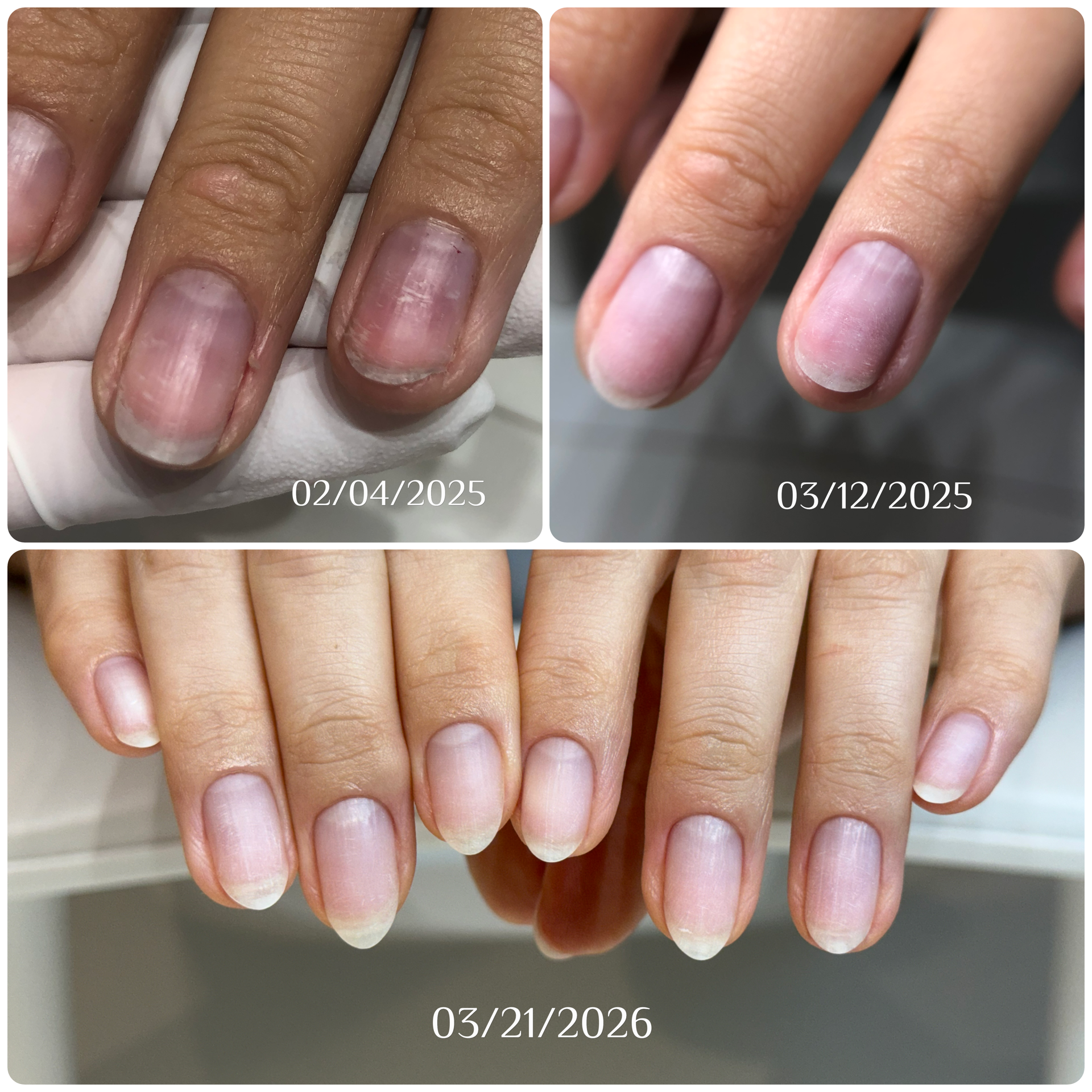
An Atelier Anaiis client’s nail care progress over thirteen months. When she came to us, there were hangnails and clear evidence of e-file damage — through consistency and patience, her nails have gained long-term stability.
Most women judge a manicure the way they judge a meal at the hardest table to book in town.
Immediately.
Do their nails come out looking beautiful? Do they feel smooth? Does it make them feel special? Their reflections center on the look and feel in the moment.
But nails are not meals. And when you’re talking about healthy nails in the long-term, you need to think with a longer time horizon – not just immediately after the appointment or the handful of days that follow, but in months.
Because nails are living structures. And living structures operate on biological timelines, not cosmetic ones.
This distinction sits at the heart of restorative nail care — and it explains why some women feel puzzled when transitioning away from highly reinforced nail systems to approaches focused on long-term natural nail stability.
The Difference Between "Maintained" Nails and "Stable" Nails
One of the biggest misunderstandings in modern nail care is the assumption that nails which appear stable are healthy.
These are not always the same thing.
Many nail systems are designed around frequent and continuous maintenance: continuous reinforcement, continuous balancing, continuous patching, and continuous cosmetic correction.
In simpler terms, we’re referring to extensions, refills, and nail fixes.
Under these systems, natural nail health is not the focal point, and is rarely assessed on its own.
This creates what we call maintained nails.
Maintained nails can appear beautiful. They can appear durable. They can appear reliable.
But that does not automatically mean the underlying nail has developed resilience independently, which is a fixture of healthy nails.
Stable nails are different.
Stable nails are nails that:
Tolerate daily life more comfortably
Bend without immediately splitting
Maintain integrity with less compensation
Gradually become more resilient biologically and structurally over time
Nails can appear stable because they’re constantly being propped up.
That’s very different from natural nails that have gained stability themselves.
This distinction is subtle, but enormously important.
Why Nails Sometimes Feel Worse During Transition
Clients transitioning away from acrylics, getting refills regularly, or used to having extensions constantly sometimes experience an adjustment period with restorative nail care.
This can look like:
Peeling
Splitting
Increased sensitivity
Shorter wear
Bending
Temporary instability
This is often emotionally confusing because new clients understandably think, “If the new approach is healthier, why don’t my nails immediately feel stronger?”
With the human body, the answer is multilayered.
Sometimes the previous system was compensating for structural weakness continuously.
In other words: the nails were not necessarily strong by themselves — they were being braced.
This is why it’s possible for nails to appear durable while the underlying natural nail struggles independently. And when the natural nail is encouraged to stand under its own power for the first time in a long while, well, things can happen.
That does not mean previous systems are inherently “bad.”
It just means that different systems optimize for different outcomes.
Many systems prioritize aesthetics over health:
Designs for a particular event
Longer nail length only possible through extensions
Continuous structural compensation
Restorative nail care prioritizes:
Biological recovery
Long-term natural nail resilience
Gradual structural integrity
Those are different goals.
And different goals require different timelines.
When Nail Strength Has Been Borrowed
A critically important idea in restorative nail care is understanding borrowed strength.
Sometimes nails appear strong not because the natural nail is actually healthy, but because external reinforcement has continuously carried the structural burden.
Imagine being on crutches after spraining your ankle. During rehabilitation, it’s almost impossible to go anywhere without the crutches – they’re absolutely necessary. But you can’t be on crutches forever. Eventually you need to – and want to because they’re so cumbersome – walk on your own two feet. It’s the only way to really walk, run, and enjoy the wonderful miracles that are your legs.
Nail extensions, refills, and nail fixes are like crutches for your nails. And unfortunately people have forgotten that, long after their initial functional need has all but become nonexistent.
So when women decide they no longer want to rely on crutches for their nails and the moment arrives to wear their natural nails without enhancements, the underlying instability becomes visible.
The strength of their nails have diminished, just like leg muscles that atrophy after a long period of not being in use. And this can often feel frustrating and discouraging.
But make no mistake – that instability that is so uncomfortable in the moment is often a crucial part of rebuilding strength.
That’s why periods of weakness immediately after transitioning to restorative nail care is not always failure.
Sometimes it’s the first honest feedback you’ve received about your natural nails in a long, long time.
Healthy Nails Operate on Biological Timelines
The modern beauty industry often conditions women to evaluate nails almost exclusively through short-term aesthetic performance.
Just like they do makeup and hair – what’s important is how they look right after the service.
But restorative nail care – really, nail health – asks a different question entirely:
Are the nails becoming more resilient over time?
That’s a biological question.
And nail biology moves slowly.
Natural nails grow slowly. In fact, only a few millimeters a month. So damaged areas grow out slowly. Which means that adaptation occurs slowly. Resulting in structural change happening slowly.
This is why restorative nail care requires patience and a longer time horizon.
At Atelier Anaiis, progress is often measured less from appointment to appointment and more by increases in resilience through seasons:
Fewer breaks over months
Less peeling
Healthier surrounding skin
Improved flexibility
Reduced dependence on reinforcement
Greater tolerance to everyday life
Biological progress is always quieter than cosmetic progress.
But it’s frequently far more meaningful.
Stability is Not Instant
At Atelier Anaiis, our goal is not simply to create nails that appear healthy temporarily.
Our goal is to help clients gradually build nails capable of greater long-term resilience.
That process is never instant.
Nails that have relied on continuous structural compensation for years often need time to relearn stability on their own.
And while cosmetic perfection can sometimes happen quickly, true structural recovery unfolds much more slowly — over growth cycles, seasons, and habits repeated consistently over time.
Healthy nails think in months, not days.