Why Nail Picking Becomes a Cycle
Women struggling with chronic nail picking are often told to “just stop.” In reality, nail picking recovery usually requires rebuilding damaged nail walls, minimizing rough skin triggers, and protecting the natural nails as they heal over time.
Table of Contents
Why Rough Skin Becomes Impossible to Ignore
Picking Creates More Picking Triggers
Why Traditional Manicures Fail
What Actually Helps Reduce The Urge
Recovery Requires Active Participation
FAQs
Before and After Nail Picking Recovery at Atelier Anaiis
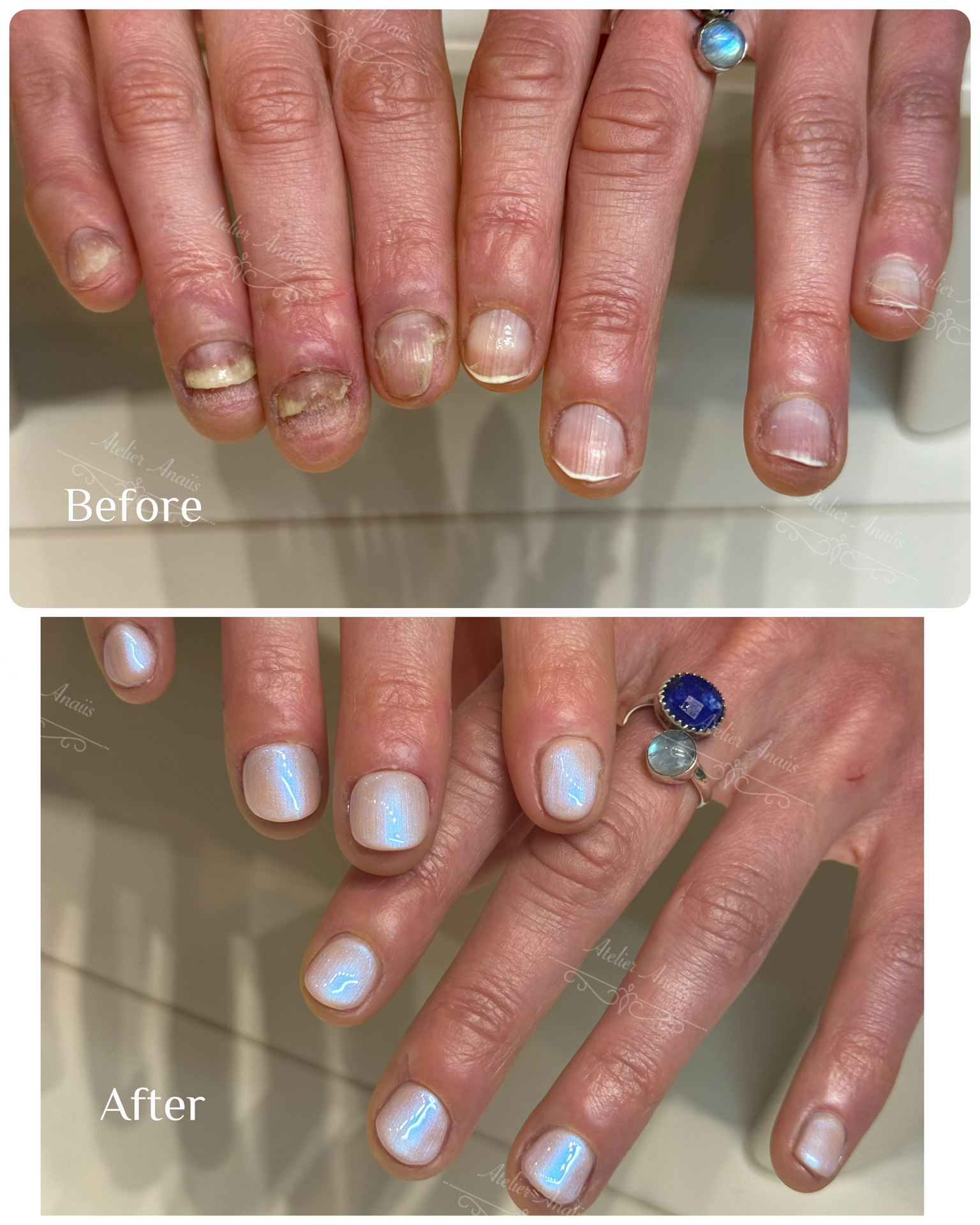
What you see here is the before and after photo from this client’s very first nail picking recovery appointment at Atelier Anaiis.
While the nails she came in with may look extreme, with proper guidance, consistent appointments, and aftercare, the client has all the potential in the world to grow beautiful, healthy, and strong nails again.
If you pick the skin around your nails, you’re probably more than a little familiar with the Internet’s top search results for nail picking or cuticle picking.
You’ll find various articles on the psychology of the habit, classified medically as a Body-Focused Repetitive Behavior disorder. You’ll find articles on how BFRBs are difficult to stop. And even more articles breaking down how stress, anxiety, impatience, or boredom may be the root cause.
So the likelihood is high that you already know why you pick your nails.
But knowing the reason does little to aid in nail picking recovery. A therapist or medication – the go-to sources of relief in the majority of these articles – isn’t going to transform your nail health.
While we at Atelier Anaiis don’t claim to understand anxiety disorders, we do understand the physical conditions that keep you in the cycle of nail picking.
Here, we’re pulling back the curtains on the physical side of nail picking and why traditional manicures fail to help.
Why Rough Skin Becomes Impossible to Ignore
Imagine you’re taking a Sunday stroll in the neighborhood. The sun is shining, the breeze is calming, and the birds are chirping happily. You break out into song, favorite coffee in hand.
And then, bam! You find yourself upside down with coffee all over your favorite outfit, pain shooting up your back. You fell into a huge pothole.
Nail picking often feels like this, doesn’t it? Everything is all good and fine one moment, and then the next moment you’ve picked on the skin around your nails, leaving you to wonder what in the world happened.
It happens so quickly, so swiftly, it’s almost like you’re not in control.
While Body-Focused Repetitive Behaviors in general are notoriously tricky to step out of because the triggers to the habit are so easily accessible, nail picking stands out even amongst the crowd.
This is because your hands are how you interact with the world most of the time. You notice – and assume everyone else notices – every rough edge, peeling nail, or skin imperfection.
Hangnails are even more triggering. There’s no pain quite like the sharp sting of a hangnail, and it acts like a homing beacon for your fingers, constantly searching for something to pick at.
And if there’s one thing all nail pickers know, it’s that they’re really good at finding rough skin.
Picking Creates More Picking Triggers
In the early stages of nail picking, it’s easy enough to deceive yourself that nothing of major consequence will happen.
The nail plate doesn’t seem to be affected. You’ve been getting more hangnails, but everybody gets hangnails, right? And besides, your nails look nothing like the examples of worst-case scenarios of nail picking that you’ve seen from your research. And those were really something else.
You think that the hangnails and rough edges will resolve themselves. You tell yourself that it’s all just temporary, that it’s because the air is so dry these days.
Unfortunately, these thoughts don’t reflect reality.
Soon, it becomes impossible to maintain the illusion that picking on the skin around your nails is having no ill effects. You discover that hangnails, in fact, do not heal themselves. Not only that, but you’re getting more hangnails and they’re lasting longer.
As nail picking continues over time, the body tries to protect itself by producing thicker, tougher skin. This thicker, tougher skin inevitably becomes the target for more nail picking and when it’s picked on, recovery takes even longer.
It’s this snowball effect that keeps going and going, leading to more and more extreme versions of inflammation, peeling, and rough edges.
Why Traditional Manicures Fail
As the consequences of nail picking become more and more alarming, many women visit traditional nail salons more frequently, in an effort to cover-up their habit.
It’s clear from conversations with our nail picking recovery clients that in the beginning, while they didn’t think visiting the nail salon would heal their nails, they also didn’t think it would make things worse. They innocently thought that having polish on their nails would help things by distracting themselves, providing a brief respite from being triggered into nail picking.
Although we can certainly empathize with the intentions behind visiting a conventional nail salon, more often than not it fails to help and worsens the nail picking problem.
1. Aggressive Skin and Cuticle Cutting
This is one of the more common complaints about past salon experiences that prospective clients bring up, when filling out our intake form. Aggressive skin and cuticle cutting is so common that if you go on Google Maps and look for any old nail salon near you, you’ll likely encounter people who’ve had negative experiences with this, leaving them with painful wounds around their nails.
Aggressive cuticle cutting can be attributed to one thing – nail techs being under pressure from management to finish services as quickly as possible.
This is because the majority of nail salons compete for business based on low prices, which means they need to go through as many clients as possible to keep their lights on and earn a living. The only way to cram more clients into each nail tech’s schedule is to shorten appointment times. It’s only natural that when nail techs are rushing, the percentage of accidental cuts increases.
For women who pick on their nails, aggressive cuticle cutting is a big step in the wrong direction, as it gives them yet another source of irritation.
2. Electric Nail Drills
The business model of fast client turnover is an important topic of discussion here because speed is the only reason that electric nail drills are used on people.
This is an open secret in the nail industry. Electric nail drills are not healthier, safer, or more accurate than hand tools.
Electric nail drills should be nowhere near raw hands marked by hangnails and open wounds, as it tears through uneven skin and damages the already-vulnerable nail plates.
3. Lack of Structural Skin Restoration
As most women who get their nails done professionally can attest, it’s exceptionally rare for any kind of thoughtful skin treatment to occur during a manicure. “Thoughtful” is key here, as the temporary smoothness achieved by electric nail drill use fails to count.
Hangnails are never treated.
The eponychium is ripped apart unintentionally.
Open wounds are painted over.
In order to take steps forward in nail picking recovery, the restoration of the skin is non-negotiable.
Proper treatment of wounds speeds up the healing process en route to smooth, healthy skin.
What Actually Helps Reduce The Urge
Through the field of psychology, we know that any habit can be broken down into three stages – trigger, behavior, and reward. Nail picking can be modeled like this:
The trigger: Physical triggers (hangnails, rough edges, peeling) and psychological ones (stress, anxiety, boredom)
The behavior: Picking on the skin around your nails
The reward: Momentary relief from emotions causing you stress, anxiety, boredom, etc.
Our work as nail picking recovery specialists deals with the triggers: we reduce the physical catalysts that directly lead to picking, which disrupts the nail picking cycle and directly aids in the restoration of nail walls and nail plates.
1. Maintaining smooth nail walls
In the crucial, foundational early stages of nail picking recovery, the main objective is to reduce the tactile triggers that lead to picking. Hangnails, rough edges, and raw skin – these must all carefully be treated so that the open wounds can heal as efficiently as possible.
Having smooth nail walls is a game-changer for those who are in nail picking recovery. And this always surprises them, because a lot of the remedies they find online for nail picking are overwhelmingly complicated.
But as a general rule, protocols that actually help always represent the shortest distance between two points; they deal directly with the root of the issue.
2. Hydrate and Moisturize
Once existing hangnails are treated, it’s essential to maintain an optimal environment for skin healing. You don’t plant a beautiful English rose in a garden just to leave it without regular watering, with weeds that could choke its roots all around it. For our nail walls, this is best accomplished through proper hydration and moisturizing.
You may think this is trivial, but there’s a near 100% correlation that we see in our clients of not drinking enough water and not moisturizing enough, with skin issues like hangnails and rough edges.
To drive the point home, those who drink plenty of water and use lotion many times throughout the day have healthier nails than those who don’t.
For our clients, we guide them to drink at least 80oz of water every day, and to moisturize at least six times a day. Yes, SIX times.
These two protocols greatly enhance skin elasticity, directly helping nail health and reducing the number of future hangnails.
Recovery Requires Active Participation
At every first-time appointment with a nail picking recovery client, we make one thing very clear.
We tackle nail picking recovery as a team. Atelier Anaiis’ role within that team is to guide the whole process, and reduce and eliminate the triggers that have led to nail picking in the past.
Your role as the client is to replace nail picking with a healthier behavior. Remember the psychological model of a habit loop: trigger, behavior, reward. To completely step out of an unwanted habit, the parts must be replaced and the cycle transformed.
In other words, nail picking recovery requires active participation.
Because ultimately, whether you want to continue picking on your nails is up to you. We cannot force change.
So while relapse during nail picking recovery is common of course, being accountable is a key component of being a client at Atelier Anaiis. Being accountable as a member of the team.
If there’s no behavior change, no effort, and no visible progress over a given set of appointments, we move on from the client.
We care deeply about our craft and helping our clients recover from the consequences of nail picking. But if we care more than you do, nail picking recovery under our guidance just won’t work.
The Atelier Anaiis method is no-nonsense. And it’s the complete opposite of passive, traditional manicures that will always fail chronic skin pickers.
If this approach aligns with you, begin with an intake so we can assess whether restorative care is appropriate.
Frequently Asked Questions
1. Why is picking the skin around my nails so hard to stop?
Nail picking often becomes a cycle where rough skin, hangnails, and damaged nail walls create more triggers to continue picking. Because your hands are constantly visible and used throughout the day, even small imperfections can feel impossible to ignore. Over time, repeated picking creates thicker, rougher skin that becomes even more tempting to pick at.
2. Does anxiety cause nail picking?
Stress and anxiety are common triggers for nail picking, but physical triggers matter too. Hangnails, peeling skin, rough edges, and inflammation around the nails can directly increase the urge to pick. Nail picking recovery often requires reducing both the psychological and physical triggers that perpetuate the habit.
3. Why do hangnails keep coming back?
Chronic nail picking damages the skin around the nails, making it more difficult for hangnails and wounds to heal properly. As the body tries to protect itself, it often produces thicker, tougher skin that becomes prone to more peeling, rough edges, and future hangnails.
4. Can manicures make nail picking worse?
Traditional manicures can sometimes worsen nail picking, especially when they involve aggressive cuticle cutting, electric nail drills, or rushed treatment of damaged skin. For women recovering from chronic nail picking, additional irritation and trauma around the nail walls can create even more picking triggers.
5. What actually helps reduce the urge to pick?
Reducing tactile triggers is one of the most effective ways to support nail picking recovery. Smooth nail walls, proper wound treatment, consistent moisturizing, and hydration all help minimize the rough edges and hangnails that commonly trigger picking episodes.
6. Does moisturizing really help with nail picking recovery?
Yes. Dry, rigid skin is more likely to peel, crack, and form hangnails, all of which can trigger nail picking. Consistent moisturizing and hydration improve skin elasticity, helping the skin around the nails remain smoother, healthier, and less tempting to pick over time.