Nail biting recovery requires more than leaving your nails alone and hoping they grow. Here are eight common mistakes that can keep the biting cycle alive—and what to do differently.
Table of Contents
Focusing Only On The Mental Side
Ignoring Physical Triggers
Leaving Hangnails Alone
Not Being Aware of The Hyponychium
Not Caring For The Eponychium
Leaving Nails Bare
Exposure to E-files
Setting a Deadline
Conclusion
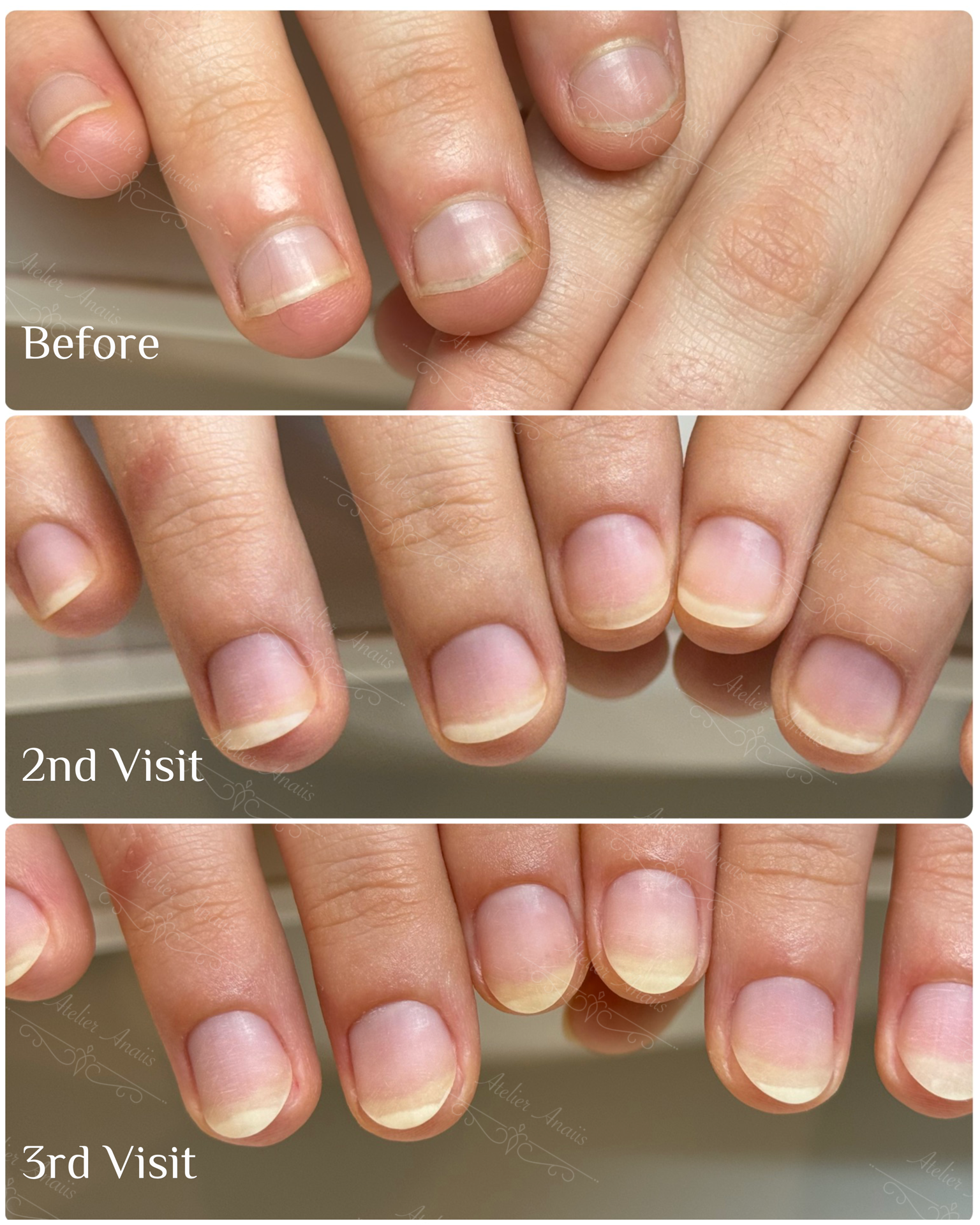
Remarkable nail biting recovery progress in just three visits.
This is a blog post about how nail biting recovery opens up once you realize that recovery–stopping nail biting, regrowing healthy nails, and keeping the behavior at bay–is not a purely utilitarian exercise. It’s about how amazing progress follows when you combine the mental with the physical and the aesthetic; and how the unwanted behavior soothes into the background once you start treating the triggers on your hands that you’ve actually been scanning for constantly, without realizing it. It’s about how limited your attempts at recovery will be when you just leave your damaged nails alone; how misguided common approaches to quitting are; and how liberating it can be to enjoy every sign of progress, of which there are many, along the path of nail biting recovery.
The eight “mistakes” in this blog post are intended as a guide to a different way of thinking based on what’s worked for our Philadelphia practice in helping nail biters have beautiful, healthy, and strong nails once again. They are markedly different from most tips to “stop biting your nails” online, since those approaches tend to have a DIY spirit to them, which–we’ve learned from our clients–ends up frustrating people when they often turn out to be a dead end. Ours is based on the belief that nail biting recovery is most successful when approached as a team, and not as a solitary undertaking. That being said, we understand that nail care studios like Atelier Anaiis can be difficult to find wherever you live. If this is the case, the following can be seen as a light at the end of the tunnel, a possibility for the future, and the knowledge that nail biting recovery is indeed very possible.
Focusing Only On The Mental Side
Many people believe quitting nail biting is a matter of the mind, of identifying the habit loop and its triggers and rewards, of having enough determination and willpower, and in some imagined way, mentally wrestling the behavior to the ground, defeating it once and for all. There’s a long list of articles online on the other side of Googling “How to quit nail biting” that talks about how anxiety, stress, and boredom give birth to nail biting, and the sheer amount of these resources that all basically say the same thing tends to make nail biters believe that once they relax–feel less anxious and stressed, and be wholeheartedly engaged in whatever they’re doing all the time–it’ll stop on its own.
But take a moment to ask yourself if you want to be, or if it’s even possible to be, relaxed at all times. There certainly are more productive and entirely unproductive ways to approach anxiety and stress, but to eradicate them is to take away emotions that make us uniquely human.
We’re not denying that emotions are one of the most common catalysts for nail biting and it can be the key to help some people get unstuck in the recovery process. But for most, focusing only on the mental aspect by way of relaxing fails as a way to reliably heal from the consequences of nail biting because by the time they seriously put an effort into quitting and subsequent rehabilitation, the behavior is already feeding on itself.
Ignoring Physical Triggers
So what exactly do we mean when we say that “the behavior is already feeding on itself?”
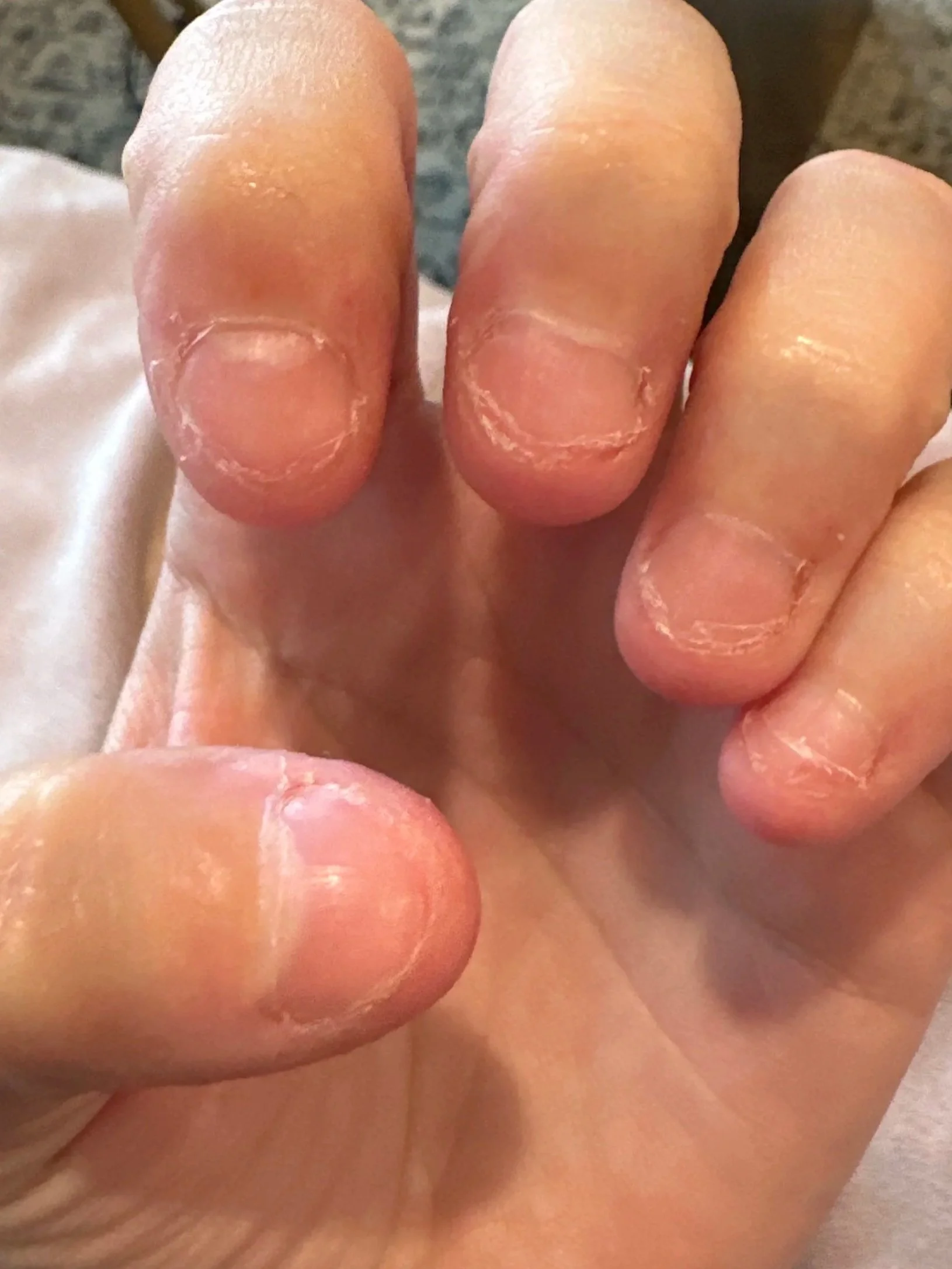
A nail biter with many physical triggers.
When we talk about habits, most of us think that it’s just doing something so often, we stop thinking about it. But neuroscience paints a more vivid picture: through repetition, the brain changes how control of the behavior is organized. This means that a behavior like nail biting that initially depended heavily on deliberation can come to be triggered by contextual or sensory cues and executed through well-learned neural circuits.
In other words, what started as a response to an emotion, after weeks and months of nail biting, no longer even needs anxiety, stress, or boredom. You can feel totally fine, but as soon as your fingers unconsciously find an imperfection, you bring them to your mouth without even realizing it. Sensory cues, like torn skin, rough edges, and peeling nails have become the primary triggers.
This explains how one can feel like they’re just spinning their wheels for months on end as they explore the mental side of their nail biting behavior. This is an experience many of us have had: the psychological is generally harder to grasp than the physical. But this turns out to be a blessing in disguise because while learning about the psychological beginnings of your nail biting has its place in recovery, it’s not even remotely necessary for regrowing healthy, strong nails.
Leaving Hangnails Alone
Chief amongst the physical triggers of nail biting are hangnails, because they tend to be the loudest and most visible, coming prepackaged with stinging pain.
Treating hangnails is, in our opinion, one of the most crucial and overlooked aspects of any manicure worth its salt, and is central to overall nail health–not just to nail biting recovery.
Healthy nails tend to be surrounded by smooth skin.
So it has to be emphasized that the go-to strategy for dealing with hangnails—leaving them alone—is wildly ineffective for two reasons. The first, as we’ve discussed in-depth in our article here, is that we devote far more neural real estate to controlling and sensing our hands than almost any other body part. This means that we naturally excel at noticing every torn piece of skin: when you combine that with stinging, irritating pain, leaving hangnails alone becomes impossible.
The second reason is that, contrary to typical thought, hangnails invite more hangnails. This makes sense because by making the decision for inaction, you change nothing about the underlying conditions that were so conducive for hangnails in the first place. In this way, hangnails are like mice who raid your cupboards: the environment has to dramatically change–smoothing your nail walls, cleaning your cupboard–or they will continue to run rampant.
But perhaps the worst part of the hangnail, in the context of nail biting recovery, is that they are an omen for extremely short nail plates.
Not Being Aware of The Hyponychium
The main cause of exasperation for most nail biters is not recurring hangnails, nor rough edges that just won’t go away, but extremely short nail plates that they no longer recognize as their own. At our nail care studio in Philadelphia, nail biting recovery prospects most often cite this as the main reason they’re seeking help with their nails.
If rapidly shrinking nail plates is the situation you now find yourself in, we empathize because the two keys to unlocking regrowth and reshaping are words you’ve probably never heard in conventional nail salons. We wouldn’t expect any nail biter to naturally know that to have strong nails once again, you need to care for two separate layers of living skin that acts as water-tight seals for the nail unit: This is the eponychium and hyponychium.
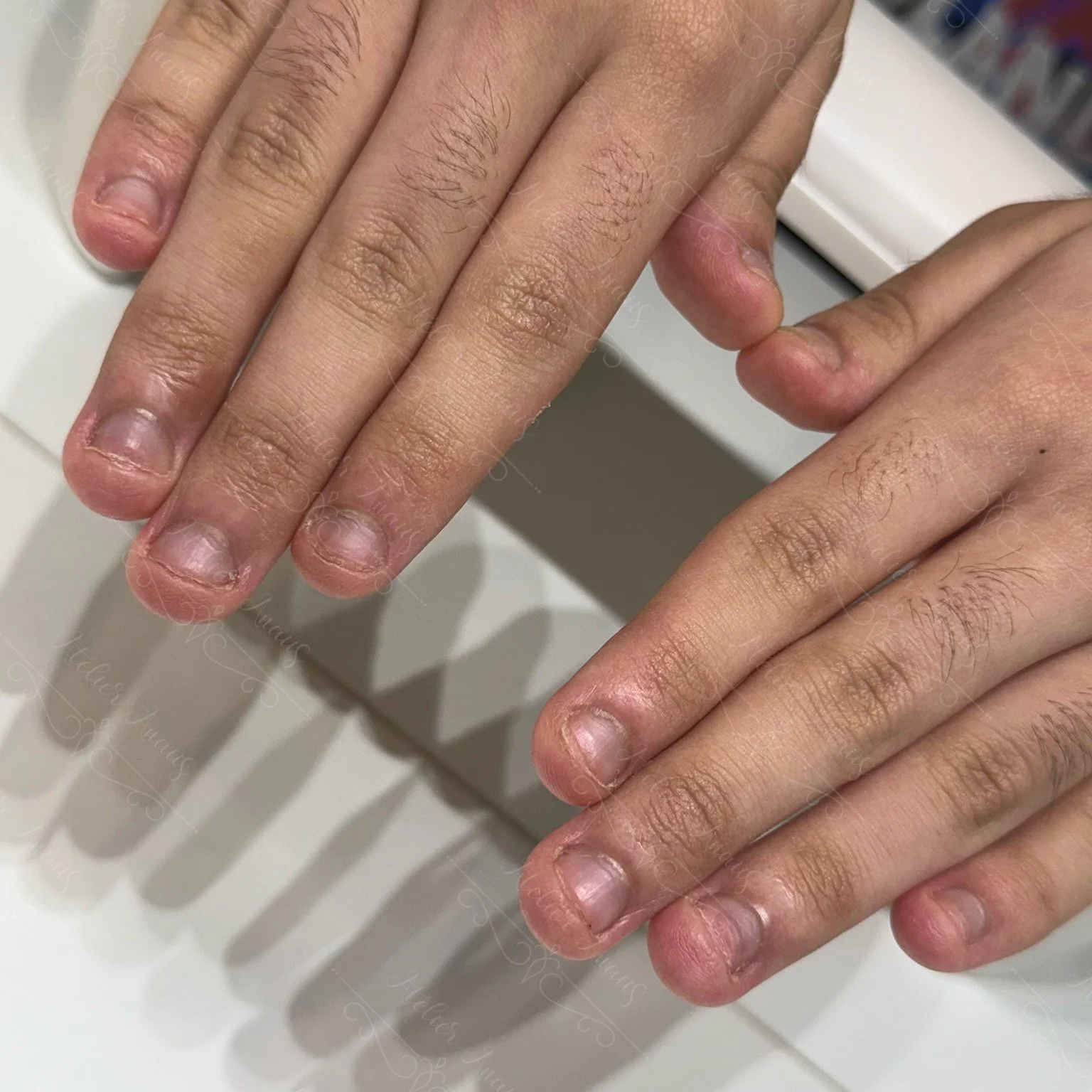
A nail biting recovery client who came in with extremely short nails.
What we see above is typical of what we see in most nail biters by the time they come to us, with extremely short nails. So how exactly do nails progressively become shorter and shorter through nail biting? The answer starts with the hyponychium.
The hyponychium is the barrier directly underneath the nail tip that keeps water, debris, and bacteria out of the attachment point of the nail plate to the nail bed. The nail bed, which is the pink portion of the finger directly beneath the nail, is no ordinary skin: It’s specialized tissue built to keep the nail plate firmly attached as it continuously grows forward, with a unique pattern of keratinization that helps maintain that attachment.
Through repeated nail biting, the hyponychium protecting the nail bed becomes damaged and detached, leaving the nail bed exposed. This is where the shortening happens: The exposed nail bed can then lose its specialized nail-bed characteristics, and essentially start behaving more like fingertip skin. The effective attachment point then retreats, producing a progressively shorter nail bed.
What’s important to emphasize here, before we discuss the similar-sounding-but-functionally-very-different eponychium, is that the hyponychium cannot be reattached through treatment. Once detached, it can only be reattached through the body’s natural processes, but for the purposes of this guide, it’s useful to know that a restored hyponychium is a crucial end result of why we treat the eponychium.
Not Caring For The Eponychium
While we agree with the idea that you should never cut the eponychium, reshaping it is absolutely necessary when it’s become overgrown, as the body tries to protect itself from the repeated trauma of nail biting. It’s only by restoring this barrier of living skin that protects the nail matrix, the origin of your nails buried out of sight, that the matrix finally has the prerequisites for producing healthier nail growth.
When we discuss the nail matrix, we like to imagine it as the nail unit’s communication tower. It receives messages from the rest of the nail unit and determines what kind of nail plate to produce in response. These messages are not just from the current conditions of the surrounding skin and the eponychium and the hyponychium, but also from excessive heat and pressure on the nail plate. Remember, one of the primary purposes of the nail plate is to protect nerves under it directly connected to the fingertips. E-files can permanently damage these nerves by way of drilling too deep into the nail plate.
Reshaping the overgrown, hardened eponychium on long-time nail biters has massive cascading effects. The thinner and more maintained the eponychium, the less cuticles the nail unit produces. The less cuticles (which are dead skin cells), the less hangnails. The less hangnails, the less physical triggers for nail biting. All of these benefits support the stronger nail plate produced by the nail matrix thanks to a restored and maintained eponychium.
That’s the foundational idea behind why we spend most of our appointments tending to the parts of the nail unit surrounding the actual nail.
Leaving Nails Bare
All of this talk about the various parts of the nail unit brings us to perhaps the most straightforward mistake to talk about on this list: leaving your nails bare.
It’s only human nature to decide to have nothing on your nails once the damage from nail biting becomes obvious, with the hope that leaving them bare will keep them from becoming worse. While the instinct is completely understandable, the reality is often that the decision is arrived at through frustration after a period of trying unsuccessfully to curb nail biting. We’ve observed that this action is taken even more hurriedly at times in a defeatist, self-punishing spirit, as if telling yourself, “I’ve been bad and I don’t deserve pretty nails.”
But this instinct has led you astray. Nails, especially very damaged ones, must be protected, so that they can safely regrow.
It’s in this way that beauty absolutely has a role to play in regrowing long, strong natural nails. In its most effective form, beauty becomes part of the nail biting recovery process, not just the goal, because it cannot be understated how much it matters to your own confidence that your nails look progressively more beautiful.
Exposure to E-Files
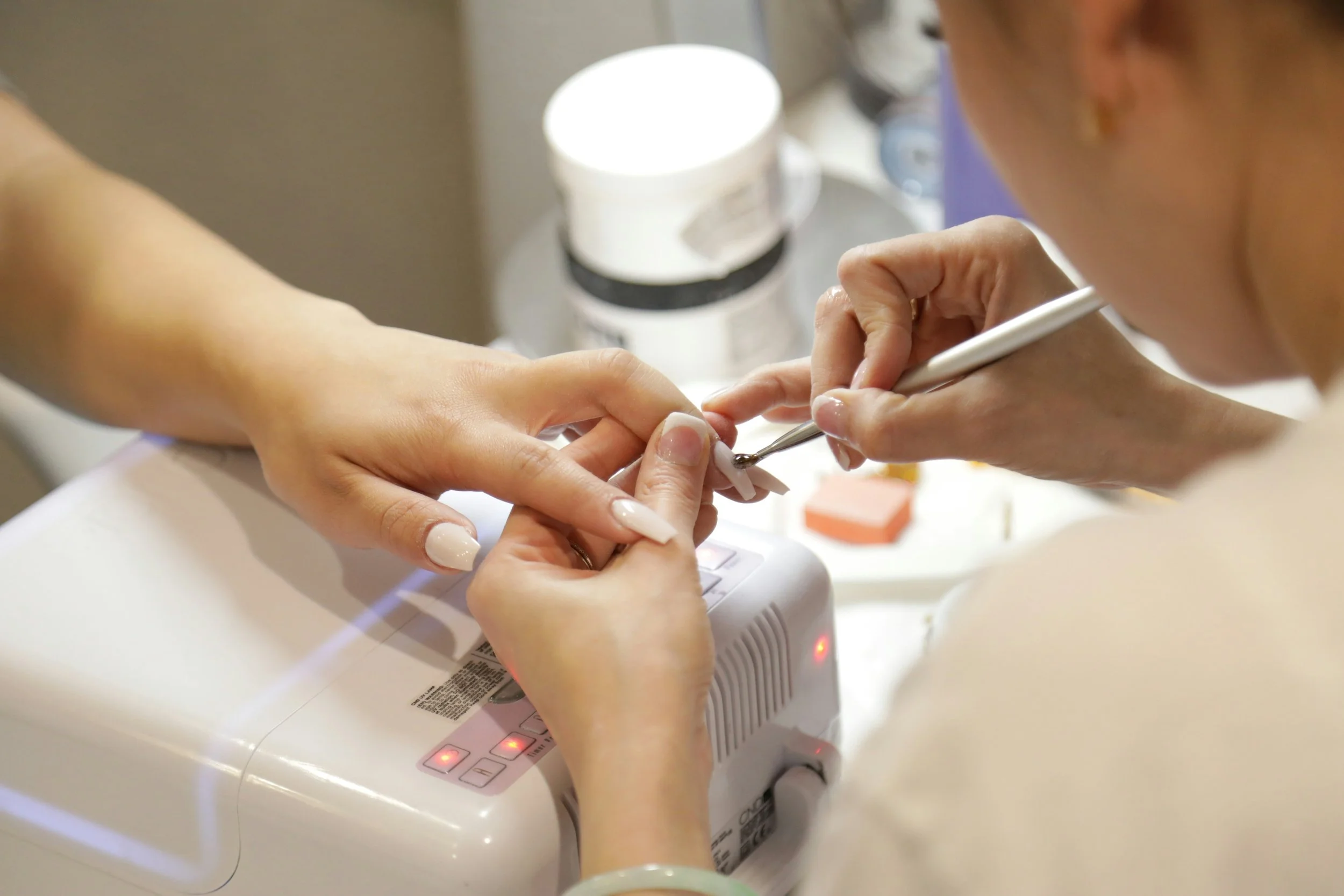
Nail drills are the single biggest threat to nail health.
With that being said, the topic of exactly what product protects your nails still matters enormously. There are many products that you can choose from, but what should be of utmost concern to you is whether an electric nail drill is used at any point in the manicure. The more we study the nails of prospects that are looking to become clients at Atelier Anaiis, the more convinced we become that e-files are the single biggest danger to nail health, bar none. And yet e-files continue to be a multi-million dollar cog in the nail industry machine.
We’re not trying to take on the entire nail industry: The amount of interested parties and people who drink the proverbial kool-aid makes that prospect less than appetizing. But we are here to let you know, since you’re reading this, that e-files will never be worth the time you seemingly save through quick manicures. E-file damage happens in a split second: It will take you exponentially longer to heal from that damage.
Setting a Deadline
In our modern culture, we seek certainty and control. Nail biting recovery is no exception: “How long will the recovery process take?” is asked by first-time clients at Atelier Anaiis, more often than not. We all want to know what the future holds for us, and we want to evaluate ourselves against an ideal, where nothing goes wrong and all is smooth sailing.
So when things inevitably don’t go perfectly, it feels devastating. You can feel like nail biting recovery isn’t possible, you can relapse into biting your nails again, and you can feel terribly discouraged. You call unnecessary anxiety onto yourself because you’re racing against an imaginary timeline all in your head that you can never catch up to.
The beautiful thing about nail biting recovery is that you don’t need to be anywhere near completion of the rehabilitation process for you to notice and feel progress. The visible decrease in the number of hangnails is delightful to note after only one appointment; the nail starting to elongate a few appointments in, brings a sense of relief that’s hard to put into words. At the end of the day, the nail biting recovery clients that have progressed the smoothest put their trust in Atelier Anaiis and our system — something that’s necessary for it to function properly. In doing so, they’ve let go of their sense of control.
Conclusion
When the eight mistakes we’ve discussed here are no longer experienced regularly, you’ll be surprised by how smoothly nail biting recovery unfurls. In essence, you stop getting in your own way and let go into the current of a recovery process closely aligned with the body’s natural processes. Our role as restorative nail care specialists is to best align the current condition of your nails and surrounding skin so that the body can most efficiently heal itself.
If you’re ready to experience nail biting recovery that meets you where you are, begin below.