Why Can't I Stop Biting My Nails?
Nail biting may begin with stress, anxiety, or boredom—but over time, the damage to your nails and surrounding skin can become a reason to keep biting. Learn why nail biting can become a self-sustaining cycle and what that means for recovery.
Table of Contents
Nail Biting Isn't One Decision—It's Hundreds of Tiny Ones
Every Bite Creates the Next Reason to Bite
Why Willpower Usually Isn't Enough
What Actually Changes the Cycle?
Nail Biting Recovery Feels Strange At First
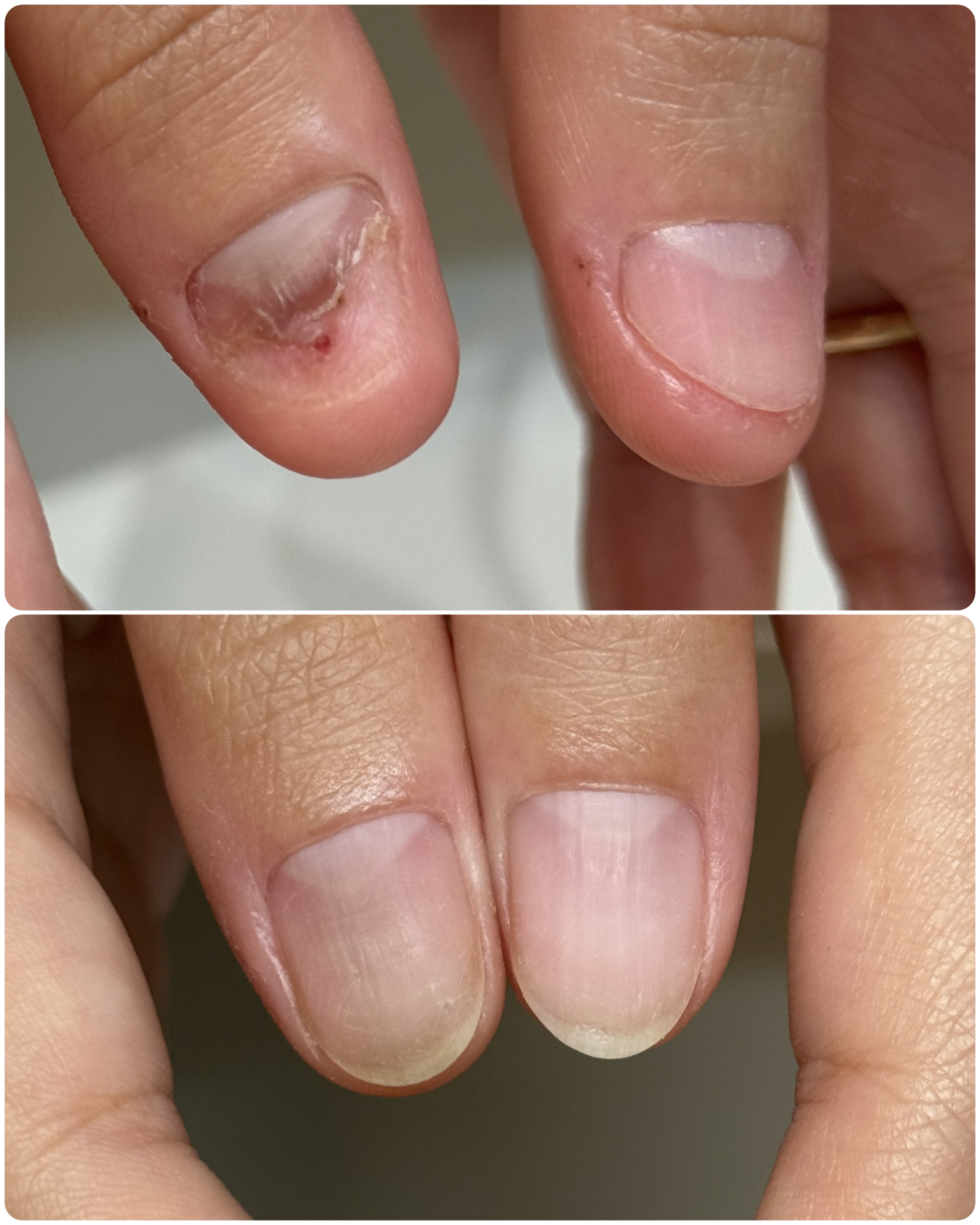
The transformation of a nail biting recovery client, whose behavior had major consequences for her thumbs especially.
If rules should serve life, rather than the other way around, it follows that to stop biting your nails, you need to analyze the psychological reasons for the habit. Stress, anxiety, and boredom; all of these are amongst the most established and well-researched reasons one bites their nails. And yet, deep-dives into the mind aren’t as sure-fire a way to stop nail biting as you’d hope. Just because you know you bite your nails after you’ve gone through a heated moment with your partner, or when you’re sweating an impending performance review at work, or when you’re just killing time while waiting, doesn’t mean the habit will cease to exist. If you’re trying to stop biting your nails, you’ll make the most progress by combining the knowledge of what the habit is doing for you emotionally, with the awareness of what’s happening physically to your hands.
In continuing to help nail biting recovery clients stop biting and transform their nails into beautiful, healthy ones, the following serves as the catalyst for our unique approach:
People assume that you bite your nails because something feels emotionally wrong. But that’s only the initial reason the habit formed. Often, you continue biting for years because something now feels physically wrong. What’s happened is that the problem is no longer feeding on anxiety or stress. It's feeding on itself.
Nail Biting Isn't One Decision—It's Hundreds of Tiny Ones
In all our time working with nail biting recovery clients, we have yet to encounter someone who wakes up in the morning intent on destroying their nails through their habit. We’d guess that if you’re reading this, you don’t do that either. And yet, that’s exactly what happens, week after week, year after year.
A critical part of understanding nail biting recovery is the reminder that you use your hands for nearly everything you do in life: to work, to drive, to cook, to workout. While it seems obvious, because so many of the movements have become automatic, the significant role your hands play in life has receded into the background as you’ve gone about your busy days.
The field of neuroscience has shown us that the hands have a disproportionately large representation in the motor cortex and somatosensory cortex (the part of the brain that processes bodily sensations like touch or pain): we devote far more neural real estate to controlling and sensing our hands than almost any other body part. In the context of nail biting recovery, this means that you’re naturally excellent at noticing every rough edge, hangnail, and uneven surface on your nails and around your fingers. And because these stimuli are so small and occur hundreds of times each day, the consequences of nail biting tends to resemble death by a thousand cuts – even when you use your willpower to override an urge in the moment, the next urge to bite is right around the corner, quickly depleting your naturally limited stores of self-control and strong determination. Like a curious and insistent cat pawing at a closed door and crying for you, eventually they find their way in. And once they come in, “just this once?” Well, you know there’s no more stopping them.
Every Bite Creates the Next Reason to Bite
Some nail biters convince themselves that through nail biting, they’re “correcting” imperfections – exposed keratin layers, jagged nail edges, hangnails – on their hands. In fact, for many of them, it’s nearly impossible to come to terms with what they’re doing to their nails, the consequences laid bare for them day after day, if they don’t reframe it in some way that’s more socially acceptable. So they reason that they’re biting their nails just in the moment, so that they won’t bite the same area later. While we can empathize, this approach encapsulates more short-term thinking that leads to the unending spiral nature of nail biting, with every bite creating the next reason to bite.
To begin with, the mouth and its teeth are as imperfect and flawed an instrument for correcting bodily imperfections as there is. There’s a reason cosmetic procedures – nose reshaping, face lifts, or really, any kind – are carried out using surgical tools, rather than the mouth and teeth. Through time, humans have naturally evolved their teeth to become optimal for cutting and biting food. Nail imperfections are far smaller than any food item one can think of, making teeth unideal and very imprecise – at best – for the task of correcting them.
Combine this with the under-explored aspect of human saliva on nail biting, a consequence multiplier to the actual biting behavior itself. With nail biting, the nail plate is rarely the only part affected. The eponychium, hyponychium, nail walls, and surrounding skin are all constantly in a cycle of being torn, re-wetted by saliva, and exposed to oral bacteria, with the moisture preventing damaged skin from sealing efficiently. This frequently results in chronic inflammation, persistent tenderness, and delayed healing, all of which heighten the nail biter’s sensitivity even more.
Throughout this cycle, biting aimed at jagged nail edges, torn skin, and exposed keratin layers never correct precisely enough, with the wetness and oral bacteria from saliva worsening the problem. This leaves an issue that never quite feels “finished” or satisfactory, no matter how much you work at it. This is how a single bite becomes self-perpetuating, creating a nail biting habit that can last over twenty years, as was the case with one of our clients.
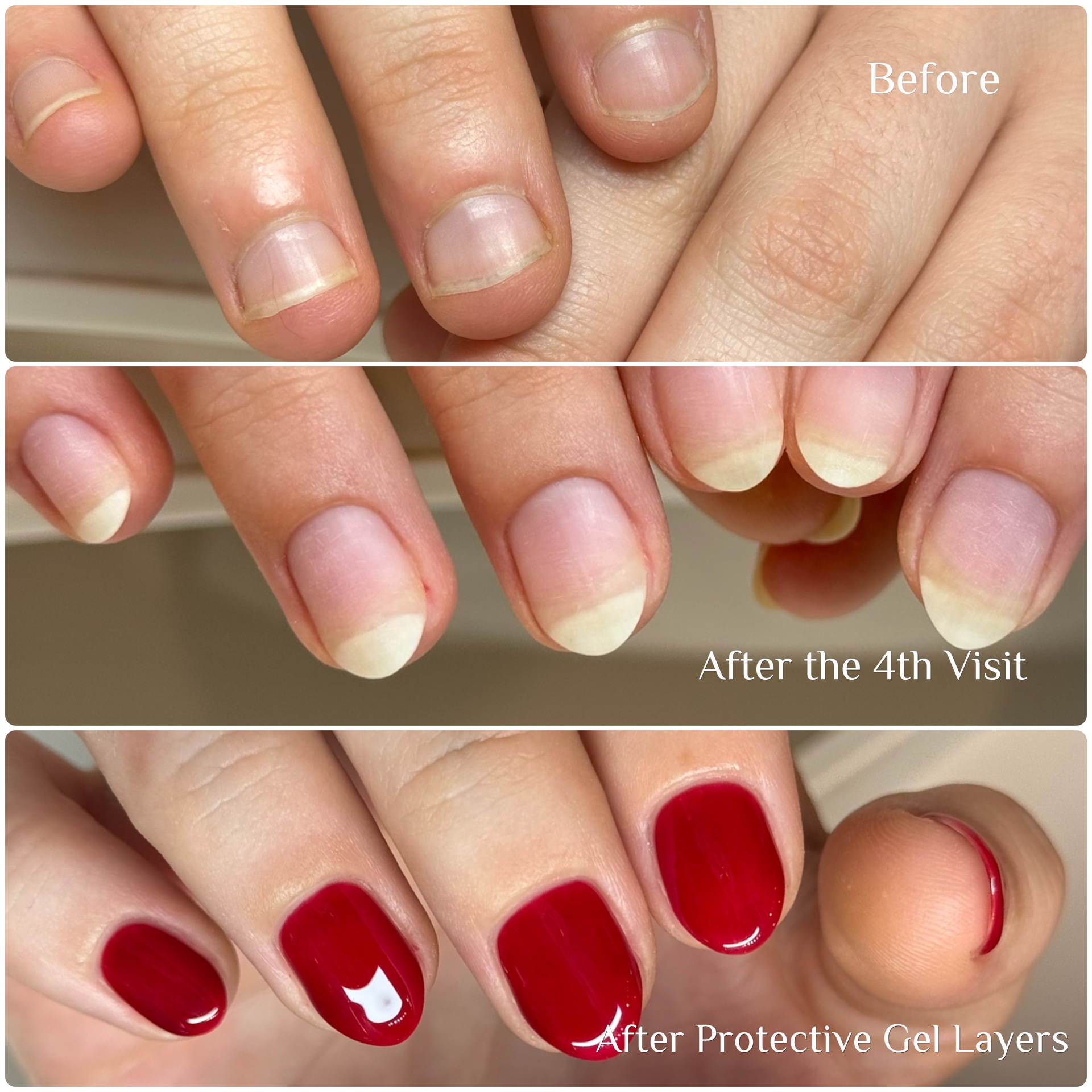
The transformation of the client, who had bitten her nails for twenty years.
Why Willpower Usually Isn't Enough
Some time ago, while researching another blog post on why most common nail picking strategies fail, we came across a Glamour article titled, “Every Strategy I’ve Tried to Stop Picking My Cuticles, Ranked.” Needless to say, it was utterly excruciating to read through. As the writer enthusiastically recommended doomed strategies like frequent regular manicures, applying cuticle oil regularly, and using bitter nail-biting serums, we arrived mercifully to the end of the article: upon finishing, we realized that the writer never got around to talking about whether any of the strategies actually helped her kick the habit for good. (We’d imagine the answer was a resounding “no.”)
Nail biting and nail picking are sometimes like two peas in a pod. In our experience, there have been many times when we discovered that a client who initially only revealed their struggles with nail biting in their intake form, turns out also to want to quit nail picking when we see them at their first appointment. Through the cycle of biting, trying to quit, and inevitably returning to the habit, they’d picked up nail picking as well. You can see where we’re headed: trying to muscle through quitting multiple habits through sheer determination and willpower alone never works.
By the time they arrive, the clients have tried all the willpower-centric strategies they found online, centered around the keywords, “how to quit nail biting.” Unfortunately, they’ve become experts on the danger in all such advice: spinning their wheels and never actually improving the health of their nails because by the time they try to stop, the habit is already feeding on itself. When your fingers and eyes constantly run into new rough edges and hangnails, with attempts to quit nail biting never addressing these physical triggers and manifestations, words like “determination” and “distraction” are rendered useless. It’s like a smoker saying, “I’m trying to quit” while standing around outside with their friends, who are all smokers; there are an unending number of triggers and fairly quickly, “Eh, why not – I’ll quit tomorrow” turns into years of not quitting.
What Actually Changes the Cycle?
And so instead of asking how to quit biting your nails, it’s often more helpful to ask: How do I stop creating things that make me want to bite?
Ironically, this generally isn’t an easy question to bring yourself to ask. Our culture encourages nail biters to look inside first and foremost – that is, inside your mind – to complete the quitting process by yourself, because otherwise, the very act of quitting would lack value. Modern culture encourages people to think of the hero’s journey as solitary. So it takes guts to step outside and ask for help: you have to be willing to accept that you gave it your best shot, and still fell short. Because ultimately, the point isn’t to use the process as another platform to prove your self-worth, but to avoid the consequences of nail biting becoming permanent.
When a nail biting recovery client commits to working with us, we work with what they have, which usually means very short, brittle nails. But the focal point of the recovery process at Atelier Anaiis is actually on what surrounds the nails, not the bitten nail plates themselves, because healing the tactile triggers of nail biting addresses nail health too. In other words, what actually changes the cycle of nail biting is removing the physical triggers of the behavior, and not just the mental ones. Reshaping the often-torn eponychium, smoothing damaged edges, and carefully removing hangnails all relay signals to the nail matrix (the origin of your nails) that you’re finally ready for stronger nails.
What actually changes the cycle of nail biting is removing the physical triggers of the behavior, and not just the mental ones.
We explain it to our clients like this: Imagine you just purchased a dilapidated property, with the buying point being a beautiful path straight into town. Well, it’s supposed to be a path – when you purchased it, the grounds had been abandoned for some time, overrun by weeds and wild bushes. You have big plans for a gorgeous path inside your head, but you know that to make that actually happen, you need to get outside and get to work. So you hire landscapers (that’s us!) and we put up a fence according to your design and clear the unwanted plants. You’re aware that one day of work is not nearly enough to bring to life this path you envision: a satisfyingly even path, climbing roses, blooming flowers, and the like. The landscapers will be back periodically, but you must physically care for the path every day as well, tending to the plants you want by watering and fertilizing them and weeding from time to time. By the time the path does indeed become gorgeous again, and you and your family revel in it, the work of tending and caring for it has become ingrained into your daily habits.
Just as in this story, it’s only through wholeheartedly engaging in addressing the physical aspect of nail biting, that hadn’t been given much attention to before, that you discover after several appointments that the urge to bite your nails – so insistent and loud before – has quieted.
Nail Biting Recovery Feels Strange At First
At this point, we’d better confront the question that prospects almost always are curious about, which is the question of “How long does recovery take?” The truth, as you may have suspected deep down, is that it depends. We know. We know. We wish we could be more specific, too. But unfortunately, because everyone’s nails grow at different rates (at most, some people’s nails grow three millimeters a month, which is roughly the size of a single black peppercorn), and recovery is contingent on how your particular body responds to the restoration processes, it’s the unvarnished truth that every client has a different recovery timeline.
The good news is that you needn’t be anywhere near completion of nail biting recovery to enjoy the fruits of the process. Stronger nails, smoother nail walls, less hangnails, and a reduced urge to bite – these benefits are all revealed to you after just the first and second appointments. Some might object that this seems too good to be true, after they gritted their teeth and yelled at themselves after so many failed attempts to quit. And of course we can empathize: who wouldn’t have the instinct to deny, not particularly because what we say is untrue, but because most people don’t like to imagine all those days trying to quit as if it were a waste of time. But it’s important to know that working with us means getting guidance on every part of the process, including the all-important aftercare at home. Because much of the healing work comes not at the appointment, but at home, as your nail plates and nail walls regrow and reshape, when you rest and sleep following the treatments. And healing is further strengthened through increased moisturizing, increased hydration, and increased awareness of what you do with your hands throughout your day.
Facing up to this reality — as our clients do — means facing up to the reality that breaking the cycle of nail biting isn't about being stronger than the urge to bite, every hour of every day. This is why it takes courage to ask yourself the question that most nail biters don’t think to ask themselves: How do you stop creating the things that make you want to bite?