This client had bitten her nails for as long as she could remember. Coming from a family of nail biters and having spent years unsuccessfully trying to quit, she arrived at Atelier Anaiis desperate for progress towards healthy nails. Through restorative nail care, protective gel care, and consistent support, her nails gradually transformed over the course of her first four appointments.
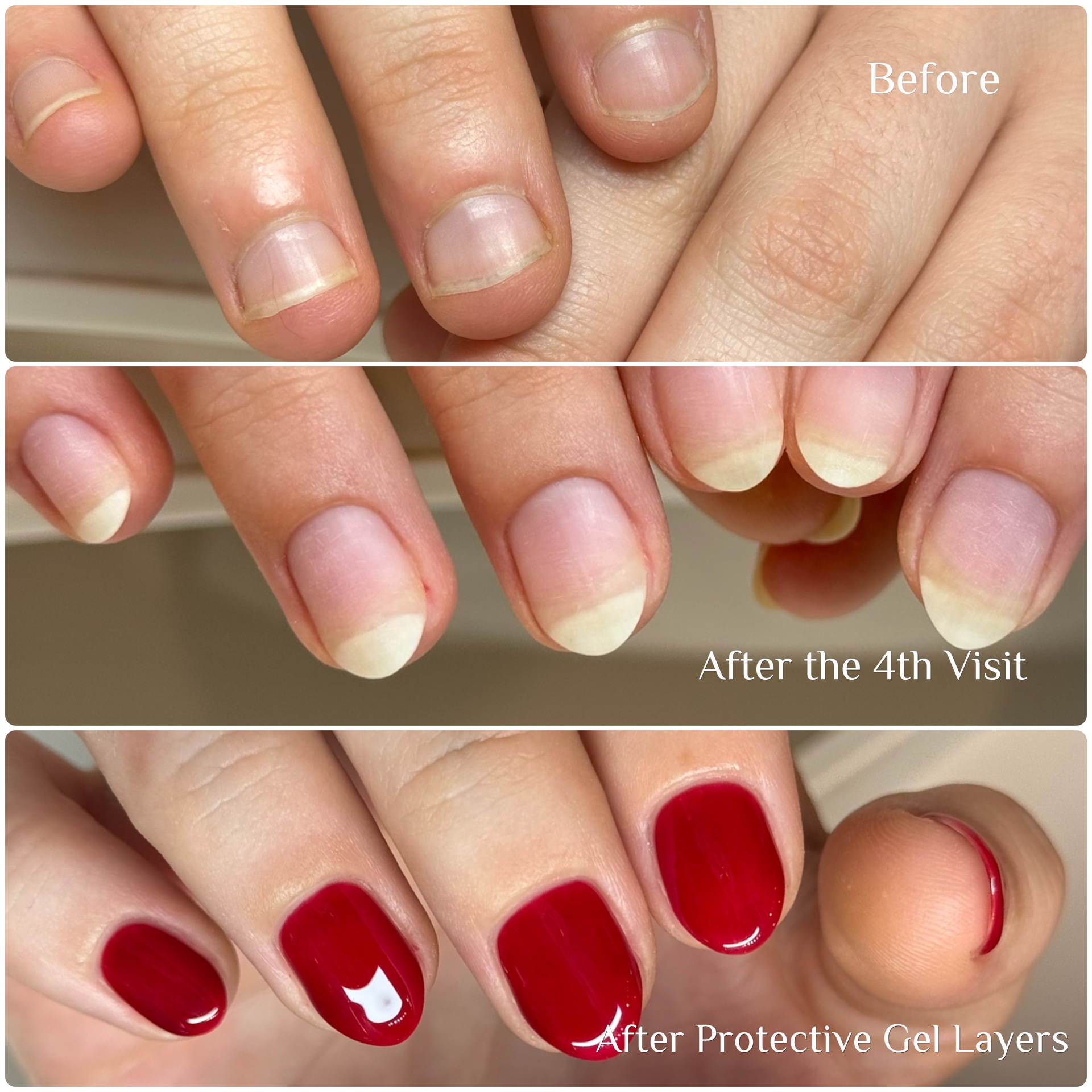
The awesome transformation of a lifelong nail biter.
If you’re visiting this case study, chances are that you’ve tried to quit nail biting for years, but have never really been able to kick the habit. Especially if you picked up biting as a child, from all the research and personal experience of trying to quit, you know that the longer you’ve had the habit, the harder it is to stop.
If this rings true, the Atelier Anaiis client in this case study is a perfect subject. A lifelong nail biter who comes from a family of nail biters, we helped transform her nails when nothing else seemed to work. And amazingly, she became the first member of her family to successfully step out of the nail biting behavior and have beautiful, strong, and healthy nails once again.
Before Nail Biting Recovery
“I have been a lifelong compulsive nail biter, and I have pushed my nail beds back. There is definitely breakage, and my nails are quite weak and thin.”
“I have gone a week without biting my nails, which is what you see in the attached picture. I do much better with not biting my nails if they are done, but I am usually not able to get them long enough to even get them painted in a salon. I am looking to quit biting my nails and have strong and healthy nails.”
“When a nail chips or the gel comes off, I tend to start biting again. I want to quit biting my nails permanently!”
– The client, in her own words.
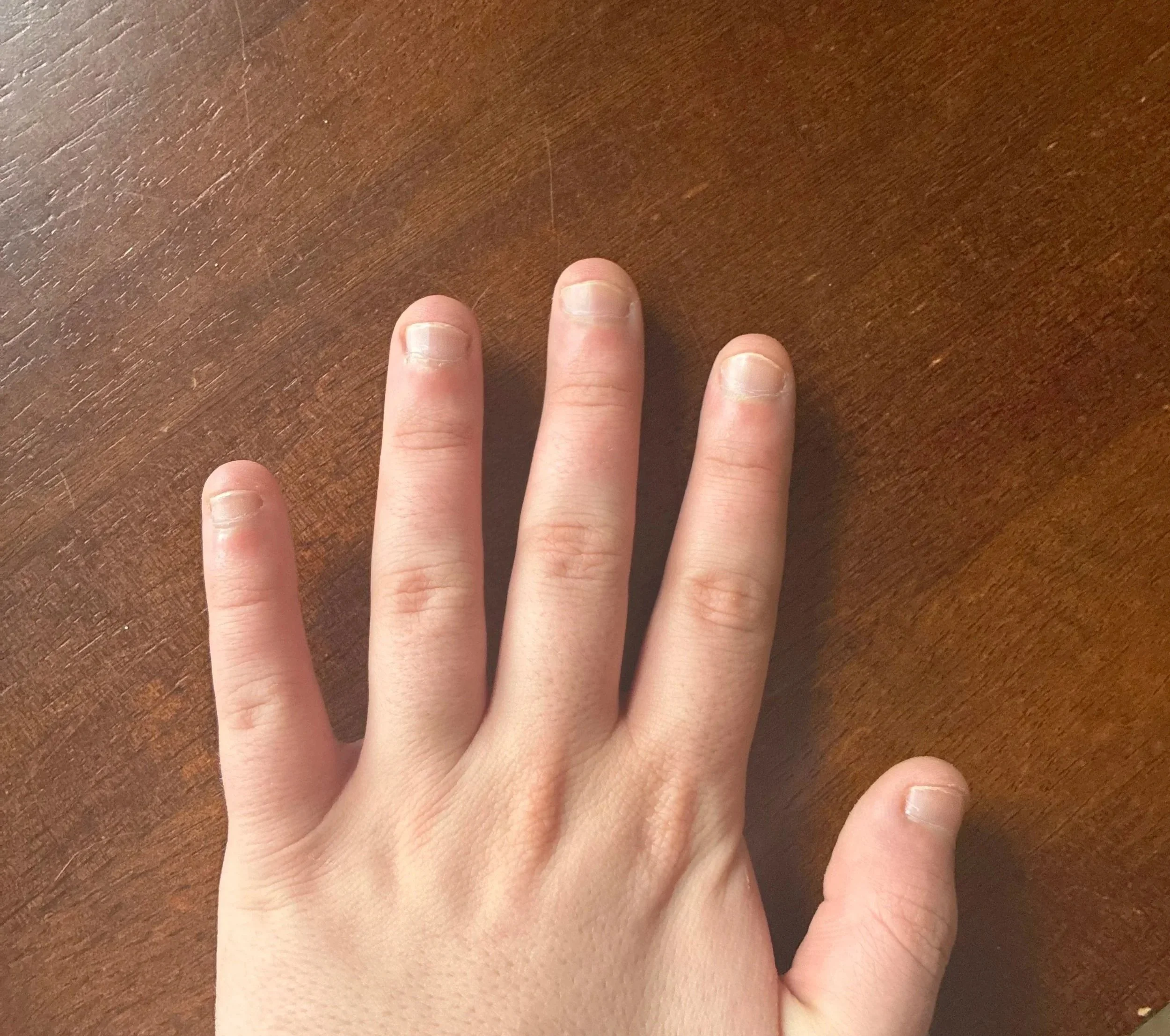
Before nail biting recovery at Atelier Anaiis, the client’s nails were extremely short, with swelling around the nails.
“I have been a lifelong compulsive nail biter”
While conventional wisdom says that behaviors learned and habitualized as a child are much more difficult to treat in adulthood, we’re here to emphasize that, importantly, “difficult” does not mean “impossible”.
Nail biting is one of many behaviors categorized as a Body-Focused Repetitive Behavior, including hair pulling, skin picking, and teeth grinding. But what makes nail biting singularly unique is the fact that it’s more socially accepted than other BFRBs.
Think about it.
Let’s say you were walking down a hallway, and happened to see someone ripping their hair out. It’d make you stop in your tracks, wouldn’t it? How would you feel? Maybe you’d wonder if they needed help. Maybe you’d cringe or watch in disbelief until you forced yourself to look away.
Now imagine the same setting, but seeing someone biting their nails instead. Compared to the hair pulling, nail biting is a lot less alarming, almost harmless. On average, we’d imagine most people have seen more instances of nail biting than hair pulling or skin picking. In pop culture, there’s even a word, “nail-biter,” often used to describe tense, exciting moments in sports, TV shows, or movies. They certainly don’t call them “hair-pullers”.
All of these factors contribute to the normalization and possibility of nail biting being learned and passed down from one generation to the next in the same family.
But make no mistake: nail biting is just as alarming and consequential as hair pulling.
“I do much better with not biting my nails if they are done, but I am usually not able to get them long enough to even get them painted in a salon.”
The awareness that nail services seem to help with nail biting is a sentiment that many of our nail biting recovery clients share, but unique to this client is the desire to use her natural nails instead of leaning on fake nails.
This might not seem like a big deal, but working with the natural nail from the very beginning of nail biting recovery is actually crucial.
Through our experience of working with nail biting clients, we’ve observed that many of them initially want to explore extensions as a way to cover-up their bitten nails. The worse shape their nails are in, the more they want to cover it up. And while there’s research supporting fake nails as a useful method to slow down the actual habit of nail biting, they don’t do anything to transform the health of the nails that are already damaged.
In other words, to grow healthy, strong nails once again, we must work directly with the natural nail without extensions.
Together with this client, we saw the situation for what it is without any illusions, and moved forward from there.
“When a nail chips or the gel comes off, I tend to start biting again.”
In the previous section, we talked about how many nail biters share the sentiment that manicures seem to help them become aware of their nail biting, slowing down the habit. The unfortunate reality is that most manicures don’t last more than ten days, so at best, they become a frustratingly short-lived distraction without leading to a sustainable solution for recovery.
The focus on longevity at Atelier Anaiis is a cornerstone of our nail biting recovery work. Through every four week period in between appointments, the robustness of our protective gel layer shielded the client’s natural nails, allowing them to reshape and regrow without being disturbed.
What helps the protective gel layer last for four weeks at a time, and what nail biting recovery demands is actually interrelated, which we will discuss below.
The Nail Biting Recovery Process
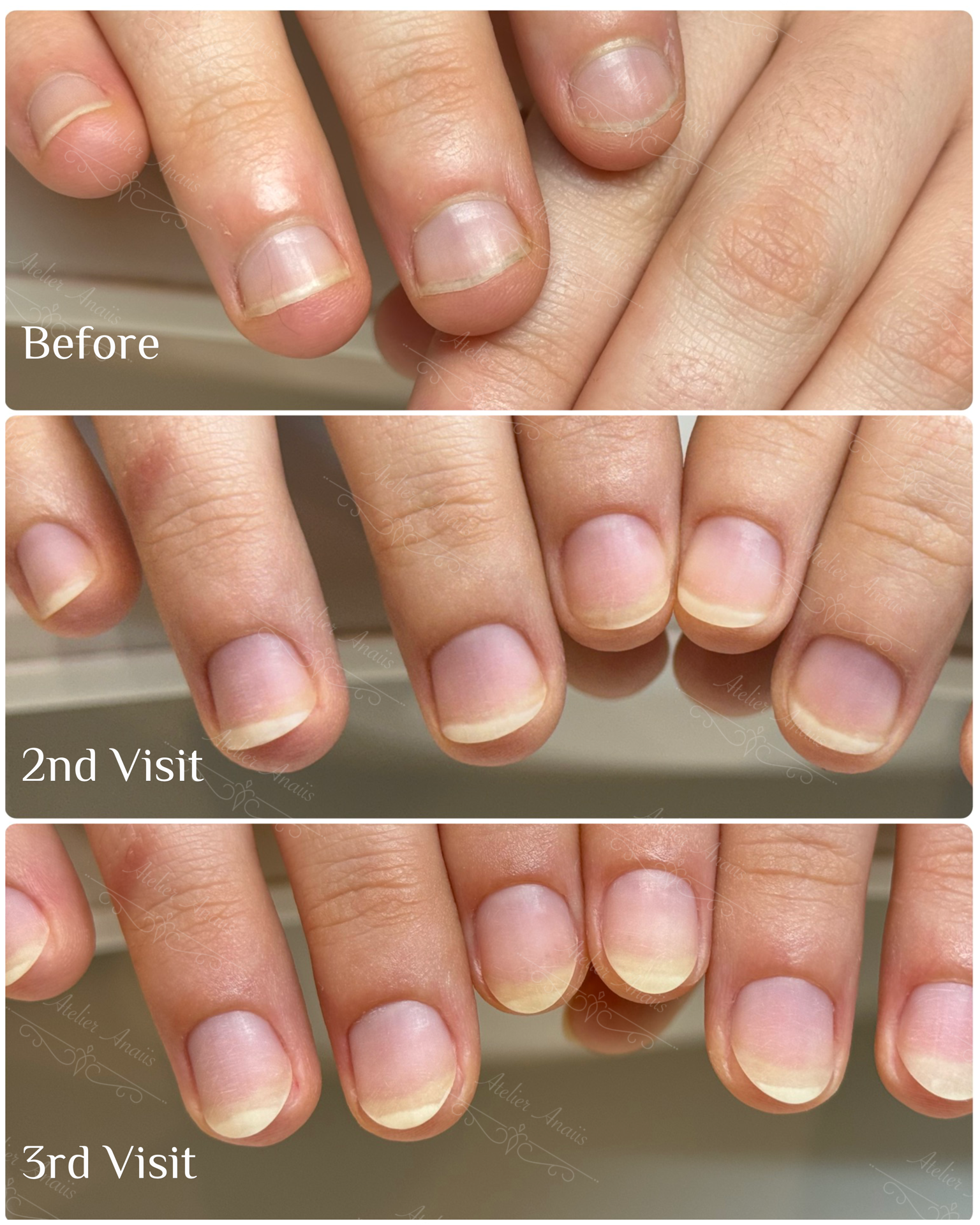
Nail biting recovery progress through the first three appointments, showing improved nail wall conditions and nail bed expansion.
What makes the biggest difference in nail biting recovery cases like this one, is treating the nail walls and skin around the nail. That’s right – to rehabilitate bitten nail plates, much of our work focuses on what surrounds the nails. This often surprises clients, as they’re used to situations regarding their health to involve a more direct approach.
If you’re having surgery, the entire procedure revolves around the reason you’re having surgery in the first place, whether that’s removing a tumor, repairing a broken bone, or replacing an organ.
But nail biting recovery isn’t surgery.
While surgeries are usually one-time occasions, nail biting recovery relies on consistent treatments over time to sustainably realign the biological processes of the client’s own body for lasting transformation. We aren’t cutting out and replacing short, bitten nails in one go – we’re creating an ideal nail environment unique to you that allows your body to shed damaged nails and grow strong, healthy nails as efficiently as the body will allow.
This approach is rooted in nail anatomy: when your nail plates emerge from the nail matrix, the cells are hardened and keratinized. This means that nails don’t require any oxygen (no, they do not breathe) and have no blood vessels, structures the body typically relies on in other parts to heal itself.
We like to imagine the nail matrix as a communications tower, receiving signals and feedback from the rest of the nail unit that influences the production and quality of nail plates.

In order for the production of healthy, strong nails to begin again, the nail matrix must receive messages that communicate you’re ready to do so, through the treatment of the nail unit. This means aspects of the process like pressure from buffing and heat created from filing by hand must all be carefully controlled. For this particular client, this also meant removing damaged skin, treating hangnails, and reshaping the eponychium at every appointment.
The treatment of nail walls and surrounding skin falls under what we at Atelier Anaiis call Corrective Treatments, as part of our Nail Biting Recovery program. And the great news is that the better the client follows our aftercare guidelines, the less corrective work is needed over time, as was the case with this client.
After just one appointment that lasted her four weeks (longer than any previous nail service had lasted her), she came back with nails that were already showing signs of restoration: less hangnails, smooth healing of damaged skin, and nail growth. Crucially, she hadn’t returned to biting her nails and every subsequent appointment has ushered in greater returns to nail health.
The Nail Biting Recovery End Game
As with our Protective Gel Care clients (those who have damaged nails but do not bite or pick their nails), nail care for nail biting recovery clients is a lifestyle. Particularly with nail biting, clients will always need to be vigilant, and the treatments and protective gel layer that enable her to have healthy, strong nails will continue to be a part of her self-care ritual as long as she deems her nails to be important to her.
Because while she has gained considerable strength, length, and comfort with her nails through just four appointments, there’s still work to be done that cannot be conveyed through pictures and words alone. The client is still in the process of shedding damaged portions of her nail, which leave her nail tips vulnerable to breakage and splits until they’re completely replaced by stronger growth.
We share this because at Atelier Anaiis, we do not sell a dream that doesn’t exist. Nail biting recovery requires patience, diligence, and commitment. But the rewards are felt daily and, for our clients, life changing.
If you’re interested in working with us to transform your nails, you may begin below.