The Origin of the Modern Manicure
When most people think of a manicure, they picture polished nails, seasonal colors, and ever-changing trends. But the modern manicure was born with a very different purpose. Long before acrylics, electric nail files, and social media aesthetics, Victorian women viewed beautiful nails as an expression of refinement, health, and patient care. Like Marty McFly returning to an altered future in “Back to the Future,” today's manicure bears surprisingly little resemblance to its own origins. To understand how we arrived here, we first have to travel back to where it all began.
Table of Contents
The Victorian Ideal
The Manicure Travels Through Time
Where The Manicure Stands Today
Atelier Anaiis: Familiar, yet New

The time machine from “Back to the Future.”
In Robert Zemeckis’ iconic comedy, Back to the Future, high school student Marty McFly is accidentally sent from 1985 back to 1955 in a time machine. Born into a family of professional and social underachievers, once he travels to the past, Marty unintentionally prevents his parents from falling in love, and must repair the timeline by bringing them back together while finding a way to return home before he erases his own existence. In the end, he successfully secures his presence in the future, all the while altering it – in one of the last scenes, we discover that the man who bullied Marty’s father in the beginning of the film, is now employed by him as a servile valet post-time travel.
Back to the Future is representative of what has happened to manicures over time. Today, most manicures everywhere are about the visuals – being on trend, having longer nails than is practical or biologically possible, square nail shapes. But when the modern manicure originally emerged in the Victorian era in the late 1800s, its purpose was completely different. Interestingly, the etiquette of the time discouraged having colorful and very long nails, considering both to be theatrical and excessive. We can only imagine that the nail trends of our time would have caused Victorian women to have a heart attack if they could time travel to 2026.
The Victorian Ideal
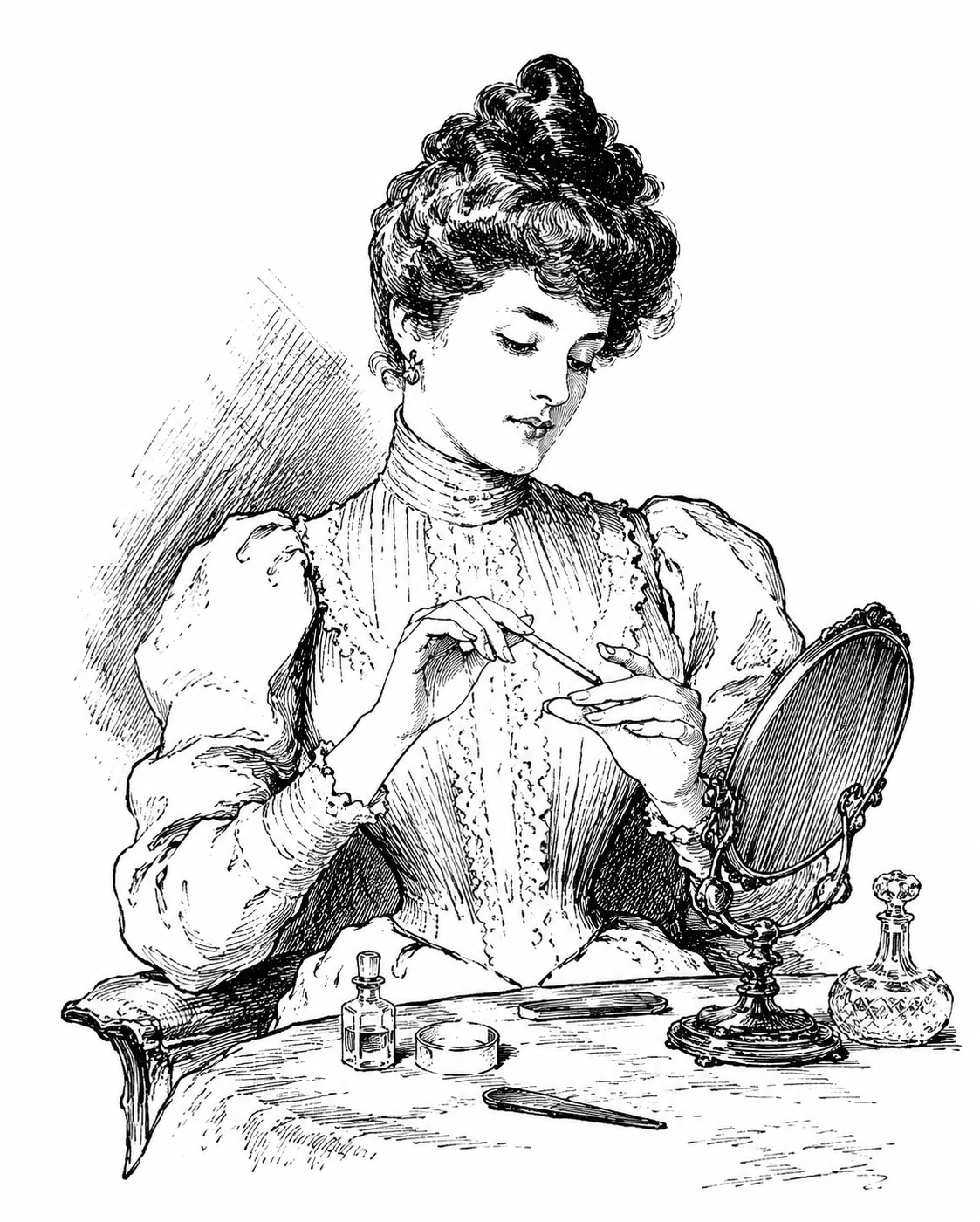
The modern manicure was born during the Victorian era.
During Queen Victoria’s reign of the British Empire from 1837 to 1901, society was consumed with the idea that one’s appearance reflected one’s character. This was a time of transition for luxury, from being noticeable and prominent in previous centuries, to flashiness being interpreted as vulgar and rude. This idea continues to be hugely influential in parts of the world today, after the global upheaval of the way we dress by blue jeans and even more, sweatpants.
In a time without the Internet and artificial intelligence, people in the Victorian era relied on etiquette books; instruction manuals for becoming a “respectable” member of society. These weren’t niche publications for aristocrats either – aimed at the rapidly expanding middle class thanks to the Industrial Revolution, they were mass-market best sellers. Titles like “The Habits of Good Society” in Britain and “Manners and Social Usages” in the United States went through numerous editions and remained in print for decades, shaping a society where incorrect manners or an unkempt appearance genuinely damaged one’s social standing and chance for upwards social mobility. Dress and manners considered “conservative” today was normal for everyone back then. The words that became staples in the English language through these books are testament.
“Refined”, “respectable”, “polished”, “tasteful”, and “elegant” – these words formed the core of a Victorian ideal that extended far beyond clothing. A refined and respectable person not only had a certain amount of wealth, but also had refined handwriting, spoke in a refined way, had refined taste, and had refined hands. For women in particular, their hands were considered evidence of self-discipline, hygiene, and social class. This was the backdrop the manicure was born into, producing nails that were short by today’s standards, with a natural shape like a soft almond, and highly buffed. With nail polish still decades away from being invented and widely used, diligence and cleanliness was the name of the game in the 1800s: above all, Victorian women wanted nails to appear healthy and refined.
The Manicure Travels Through Time
As this blog post on Victorian manicures lays out, the routine of manicures back in the 1800s did not involve nail polish, focusing instead on the natural health of the nails. Their practice is clearly recognizable to nail professionals today who care about their clients having healthy nails.
Wash the hands and soak nails in warm, soapy water.
Clean underneath the nail.
Push back softened cuticle.
File and shape the free edge into a nice oval.
Massage oils or creams into the nail.
Buff the nail to a natural gloss.
At the time, manicures were done at home, consuming important chunks of time in Victorian women’s days. The aforementioned etiquette books are evidence of this, as are the dedicated manicure sets that were crafted from sterling silver, ivory, or mother-of-pearl: these were prized personal possessions for Victorian women, and showed the manicure being established as an elite pastime.
The word “pastime” evokes a sense of enjoyment taking priority over time, appropriate here because Victorian manicures took hours, even for the well-practiced individual. With the nail and surrounding skin being quite fragile, attempts to rush would not only have hurt, but any sort of blemish would have been carefully avoided so as not to defeat the entire purpose of tending to their hands. While actions like pushing back softened cuticles and buffing the nail aggressively to achieve a high shine are no longer part of the standards for nail health today, the point is that the Victorian manicure prioritized doing what they thought was best for healthy nails.
As time has moved forward, technology has assured us that we’re able to get more things done faster, with more speed. Manicures are no exception. Towards the end of the Victorian era, the transition from home grooming to professional manicure began, with the first American nail salon being opened in Manhattan by Mary E. Cobb. The shift of the manicure becoming something one could receive from a trained practitioner, and not just performed at home, reflected American and European society’s increasing obsession with time, work, and efficiency post-Industrial Revolution.
Fast forward to today, and it’s undoubtedly true that professional manicures are done faster than ever before, with service times averaging just thirty minutes across the industry. But speed, it turns out, is a dubious virtue, since our decreasing tolerance for delay is reflected in the ever-increasing percentage of women who’ve experienced nail damage from electric nail drills and other conventional salon practices, which require–always an unfortunate surprise to clients–time and resources to rehabilitate. Working too hastily means nail technicians make more errors, which cannot just be taken back and corrected; an e-file drilling too deep is guaranteed to result in the painful and lasting consequences of thin, brittle, and damaged nails. What we’ve gained in speed over the course of time, we’ve lost in attention to nail health.
Where The Manicure Stands Today
There may be no more vivid demonstration of how far the manicure has veered off its original course than the daily, lived experience of many women with their nails. Over the last decade or so, more and more people have begun to self-identify cases of brittle, thin nails, persistent hangnails, and a dull throbbing in their hand that they try to pass off as temporary conditions that will go away on their own, which inevitably never do, with the accompanying realization that the quick manicures they’ve been receiving are far more damaging than they realized.
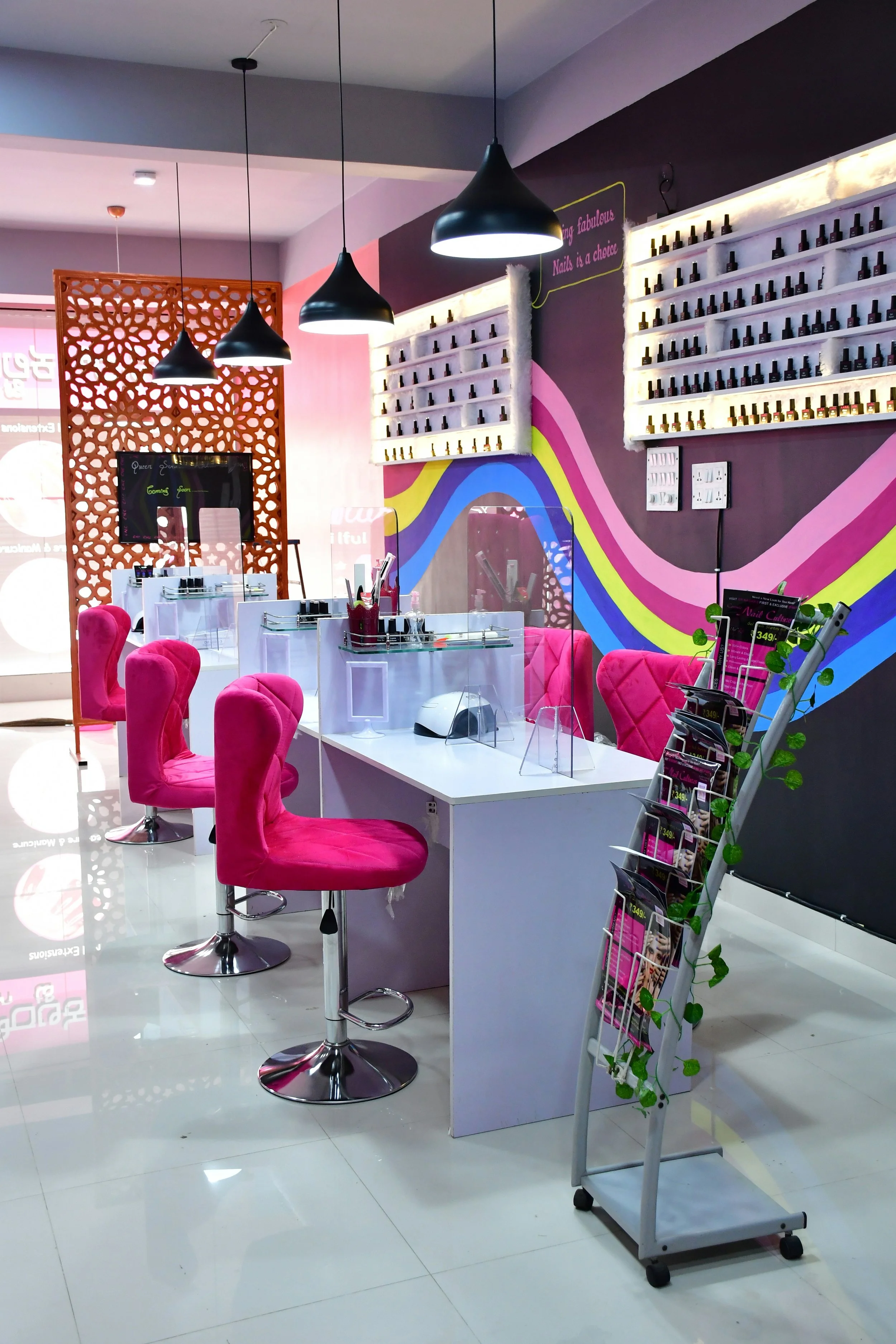
What the typical modern nail salon looks like.
“I’ve had awful experiences where getting my nails done left them yellowed or flaking after.”
“Nail techs have been harsh with my nails, over-filling them very thin.”
“I’ve tried lots of salons that people recommended but who left rings of fire or were over-zealous with the e-file. One place gave my nails an infection that took months to treat.”
“I felt like there was a forced choice between looking nice and preventing damage to the nails,” laments real women who reach out to us, looking to become clients at the Atelier. Most of them have been living with nail damage for months, if not years, an experience made exponentially more frustrating because nail damage occupies a medical grey space in most cities: not “serious enough” for the hospital and the realm of doctors and health insurance, yet maddeningly persistent, ineffective, and stressful when treated at home. Being unable to quickly rehabilitate their nails when they believe they should be able to is clearly torturous, with many eventually concluding that “nothing works,” returning to conventional nail salons to cover up and hide their nails, worsening the damage they have.
People complain that all manicures – especially gel manicures – are damaging and bad, but the reality is more indicative of our obsession with saving time. It’s not so much that manicures are inherently bad, or that they’re damaging, but that we’re unwilling to accept the truth that health-focused nail services are the sort of activity that largely operates according to its own schedule. You can’t hurry it very much before the experience begins to lose its meaning; in this way, if one cares about nail health and having strong, healthy nails, the ubiquitous, quick, thirty minute manicure will never get you there.
Atelier Anaiis: Familiar, yet New
In a world where nail polish and aesthetics have become the sole focus of most manicures, Atelier Anaiis’ restorative nail care shares its DNA not just with the original health-centered manicure, but with the original refinement-centered manicure. Much like Marty McFly in Back to the Future, in the present, we combine the best of both worlds: health as the means to refinement and beauty.
The solution to this mystery, of wanting our nails to be naturally strong and healthy while also looking beautiful and smooth on the visible surface at the same time, lies in coming to terms with human finitude: that every meaningful choice we make necessarily excludes countless others. When we decide that nail health is important to us, we’re forced to face the reality that proper nail care cannot possibly be done in half an hour; that regular polish, acrylics, and dip powder will always be short cuts that create long delays; that electric nail files will reliably lead to painfully thin and brittle nails; and contrary to popular belief, gel can be a non-penetrating shield that protects natural nails as they reshape and regrow.
The work we do sprouts from the seeds of belief that nothing looks better than genuinely healthy nails, precisely because healthy nails are an expression of the gift, as they originally were, that nature bestowed on each of us. That’s what we mean by “restorative” nail care – it’s the act of returning our hands to their earlier condition through methods that prioritize nature and anatomy above impatience, before quick manicures, nail biting, and nail picking shaped them to the point we no longer recognized them as our own.
Like a bespoke shirt-maker who takes time to measure our limbs and plans ahead by pre-shrinking fabrics, every client at our nail care studio is treated as the individual that they are. Every service is altered and adjusted, based on the condition of the particular client’s nails and surrounding skin they first arrived with, the habits they’re trying to quit, their occupation, and their age.
For Victorian women, the entire point of the manicure was for their nails and hands to be healthy and refined. Their nail care had a singular kind of focus, liberated from the impatience and rushing that plagues and dooms modern manicures. And today, Atelier Anaiis clients reap the reward of their original mission.