Cuticle problems are among the most common concerns we hear from clients. But what if the difficulty isn't just how you're caring for your cuticles—it's what you understand them to be? The distinction between living skin and dead skin changes everything.
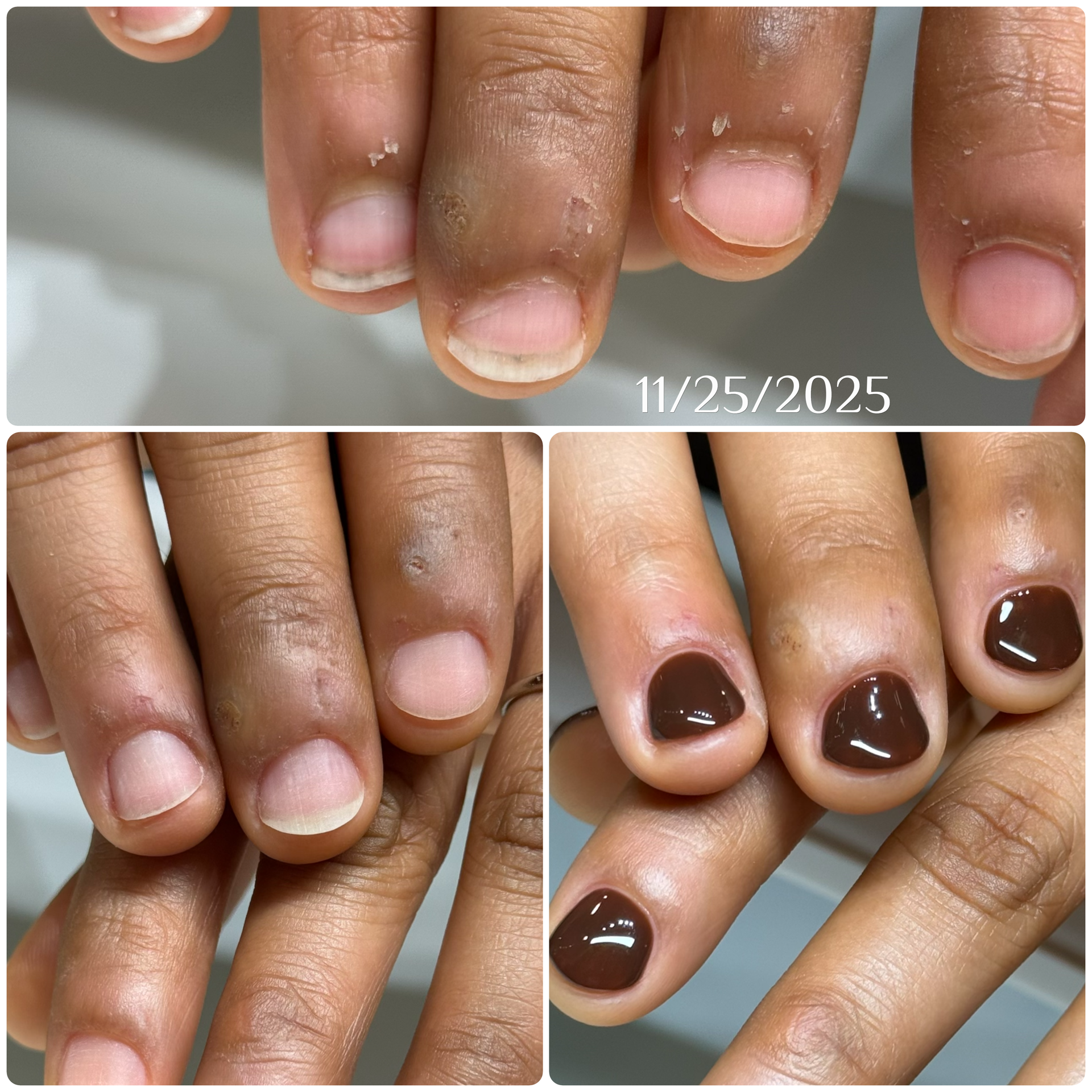
Table of Contents
“Cuticles” and Nail Quality
Nail Growth and Living Skin
Comfort — A New Standard of Nail Care
Rethinking the Cuticles
“I would like to improve my cuticle health.”
“I have cuticle issues.”
“My cuticles and skin around my nails are a huge issue I’ve been trying to figure out how to solve.”
More than half of the people who reach out to our nail care studio in Philadelphia come to us with “cuticle” problems. The three comments above are from the most recent intake forms we received.
The frequency with which we consult on these problems leads us to believe that there’s many more people out there struggling with this.
But why are “cuticle” problems so common and seemingly difficult to solve?
Based on the hundreds of conversations we’ve had with first-time clients, it’s dawned on us that there’s a general misunderstanding of what the “cuticles” even are. When you, as the client, have one definition of “cuticles,” while the service provider has their own definition, it’s no wonder that a lasting solution cannot be found. While both parties assume they’re talking about the same thing, they’re not.
That’s why one of the first things we do when a client comes in for their initial appointment at Atelier Anaiis is to clearly define what the “cuticles” are.
Because the cuticles are not just one thing.
There are two individual and separate components of what people often refer to as the “cuticles”: living skin and dead skin.
Unfortunately, this misunderstanding is not just limited to those who receive manicures – many professional nail techs also fail to recognize the difference between living skin and dead skin. Which leads us back to why “cuticle” problems are so difficult to solve.
If there’s one thing we want you to take away from this article, it’s this: Cuticles are dead skin. There’s no discussing health or improvement for something that’s already dead, and understanding this has an outsized impact on the path to healthier nails. In this article, we’re going to explore how this perspective affects three distinct angles of nail health.
"Cuticles" and Nail Quality
If you were to take a survey asking people what they think of as the defining tool of the modern manicure, we’d bet that the majority of answers would point to the electric nail drill. Filling the air of nearly every nail salon far and wide with its high pitched whine, nail techs use the nail drill to remove existing products, and prepare the nail for the application of new product. While we’ve already written about why electric nail drills will never be a part of what we do at Atelier Anaiis, thinking about it in the context of differentiating between cuticles and living skin asks the topic for a revisit. Looking at this through the trendy manicure of the last few years — Russian manicures — is particularly illustrative.
Perhaps more than any other manicure, the relationship between the Russian manicure and e-file is strong. It’s practically a symbiotic relationship: Without nail drills, it arguably cannot be called a Russian manicure. According to this Glamour article, “The Russian manicure technique removes as much skin as possible from the nail area, which leaves more room for polish. This results in a “cleaner”-looking finish and helps to extend the length of time between appointments, as the skin and nail take longer to grow back than with regular manicures.”
In another article, this one by the popular website Byrdie, “Unlike traditional nail salons where your hands are soaked in a bowl of warm water to soften dead skin cells followed by push-back tools to clip cuticles, Russian manicures clean up your cuticle by using electric nail bits. ‘First, we clean the nail bed with one type of drill bit, then the cuticle is removed with a second type of drill bit. The third step is polishing the nail bed and creating the desired shape.’”
While there are plenty of detractors of the Russian manicure — according to the same Glamour article, there are over 100 million TikTok videos that address its dangers — our argument against it is a more nuanced one, because removing cuticles is something that we also do at Atelier Anaiis.
Two major differences exist in our methods. First, differentiating between the living skin and cuticles means that the removal of cuticles is a byproduct of our caring for the living skin. In other words, we don’t remove cuticles – or “as much skin as possible from the nail area” – just to achieve a “clean” look. The eponychium — aka “living skin” — seals and protects the nail matrix, where nail cells originate from. Through years of rehabilitating damaged nails, we’ve observed that thick, unmanaged eponychia affect the quality of nails that the nail matrix produces and also consistently produces excess cuticles. In our work to reshape the eponychium, we gently remove excess dead skin.
Second, we never use e-files, instead relying on hand-only techniques. This is where we put our money where our mouth is: using hand techniques is much slower, allowing us to actually differentiate between cuticles and living skin. In contrast, parts of the eponychium are often ripped into by accidental e-file nibbles during Russian manicures, and the protective seal is then broken, allowing bacteria, debris, and water to breach it. This then affects the quality of keratin layers that the nail matrix is able to produce, leaving you with thinner, more brittle nails.
We’ve encountered many clients and prospects who had initially enjoyed the “clean,” cuticle-free look that Russian manicures had given them. But they eventually stopped and came to us for help because their nails were breaking, peeling, and feeling weak following these manicures that clearly removed too much and planned very little. So we ask you: What is the point of removing “as much skin as possible” if it leads to lingering nail damage and lasting nail issues?
Nail Growth and Living Skin
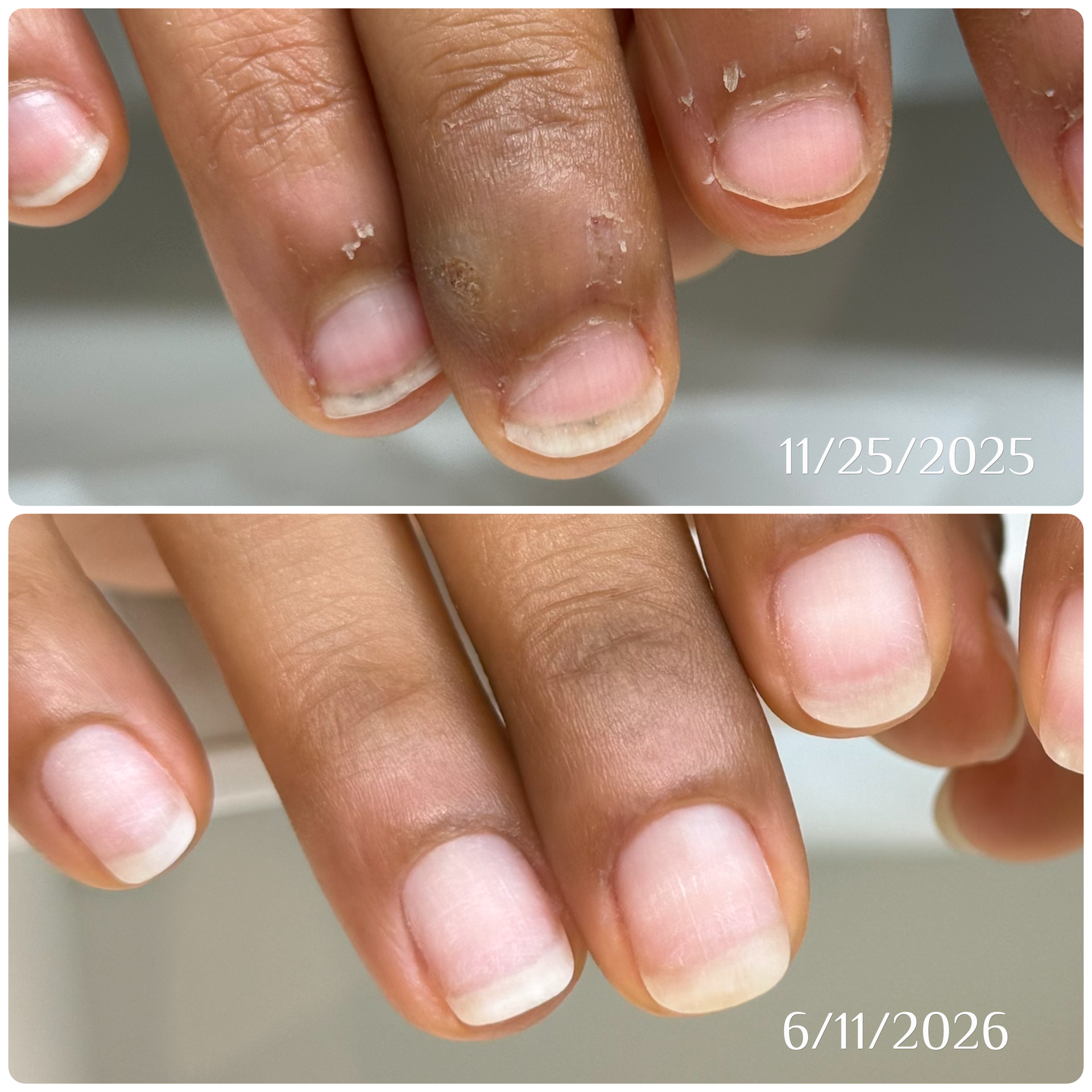
Our client’s nails before, and after six appointments spaced apart every four weeks.
Differentiating the living skin from dead skin also has an enormous impact on nail growth.
While we discussed the Russian manicure and the dangers of “removing as much skin as possible,” admittedly, it’s more common to see the opposite end of the spectrum in the nail industry: most conventional manicures do very little with the skin surrounding the nails, leaving cuticles alone.
But leaving dead skin on the fingers has unintended consequences. Especially for those who tend to air on the side of minimal intervention, like to leave things “natural,” or have been simply too busy to make nail care a priority, this often comes as an unwelcome surprise.
That was the case for our client Autumn, a busy woman with a career in law and a mom of three young kids. (Her name and details have been altered to protect her privacy.)
Throughout her life, Autumn treated manicures as a special occasion, having her nails done to celebrate milestones (primarily her many graduations from numerous diplomas and degrees). As someone who worked tirelessly for her academic achievements, leaving things “natural” – whether it was her face, her hair, or her hands – was a choice she felt she had to make early in life. She wasn’t studying to become a model, and besides, her parents had always told her she looked best without having anything done. When she became pregnant later in life with not just one, but three babies, it only served to lower the idea of caring for her nails down her list of priorities.
Her life after becoming a mom was optimized between continuing her career and raising her kids: Those were her two priorities. That’s how the past decade had unfolded, and now the kids were at an age where every minute outside of work was spent shuttling them back and forth from various after-school activities. Her nails disappeared into the background, an afterthought beyond afterthoughts.
One chilly fall day, as she waited for her kids to come out of school in the car while talking to the secretary from her office on the phone, the afternoon sunlight hit her hands. For the first time in what seemed like decades, she really looked at her nails, and whoosh – she couldn’t hear the secretary anymore. All she could focus on was just how short her nails were. But not short in the sense that she'd accidentally trimmed her nails too short, which she’d done a few times in her life. This was different. It was as if her nail beds had been zapped, suddenly halved in length. Even after she’d heard the car doors open, her kids piling in, and she began to to drive, all of it was in the background, her mind disturbed. She’d had no injury, hadn’t gotten sick, and her fingers weren’t painful at all. Sure, she had lots of hangnails but that wasn’t anything new. She simply no longer recognized the stubby nails in front of her face as her own.
Soon enough, the car pulled into the driveway, the garage rumbling open. Her kids got off and she turned off the car, but Autumn continued to sit in the driver’s seat while the biting cold air filled the otherwise quiet garage. She was alone and consumed on her phone, researching what could be wrong. She browsed through a number of articles describing serious nail disorders, gasping at the graphic photos that accompanied the text, but none of them quite described what was happening to her own nails. So the rest of the evening went, her mind flitting back and forth about the state of her nails, even after she came in from the garage.
The next day, she was surprised to find that her perspective on her hands had been altered completely. Not knowing what was happening to her nails bothered her and she could no longer ignore them, and she was even more bothered that this newfound anxiety about her hands took away focus from her family and her work, the two things she’d so carefully safeguarded for the last ten years. Throughout the week, she spent countless hours wondering if she’d ever have healthy nails again: All she wanted was to go back to living her life just as it was before, without worrying about her nails.
She channeled some of her anxiety into trying the self-remedies she found online, along with those that AI suggested. It was a frustrating process to say the least – every new remedy was accompanied by the gleaming hopes that this would finally be the solution that solved her problems, only for her to be let down in the end. Nothing seemed to work.
After two weeks of this, she finally had enough. She’d found Atelier Anaiis during her initial search online but at the time, she’d skipped over it, so consumed was she trying to fix the problem through every possible solution she could find.
But now, it dawned on her: She needed help identifying what the problem was in the first place. She felt dizzy and lost in the tidal wave of information she’d been hit with, and she needed someone to help make sense of it all.
Autumn arrived for her first appointment at Atelier Anaiis exactly a year ago, and what we saw at her first appointment characterized the nails of someone who’d left their hands and nails to fend for themselves for years.
We explained to Autumn: When nail beds recede and nail plates become shorter, most people assume that there’s something wrong with the nail itself. But especially in cases of near-abandonment, we find that the unmanaged living skin and excess cuticles play an outsized role in hindering nail growth. The living skin is often the actual problem.
When Autumn first arrived, her eponychium had been so unmanaged, it had split multiple times over the years. While this didn’t bring any noticeable pain (in many ways making the nail issue more difficult to identify), it had certainly affected the nail matrix. As the epicenter of nail growth, the nail matrix relies on a healthy eponychium to keep it safe from bacteria, debris, and water. And regular care is crucial to maintain its health.
Think about the car that you drive. By driving it regularly, it requires periodic maintenance: Oil changes, putting air in the tires, checking the battery. But in many ways, this maintenance that so many people find annoying, is exactly what keeps the car running smoothly so that you can avoid facing bigger issues when you’re on the road by yourself one day. Car problems are unavoidable: Afterall, they’re not meant to last forever. You have the choice of preventing it through regular maintenance, or endangering yourself in the hopes of fixing it once it blows up in your face.
After six months under our care (six appointments spaced apart every four weeks), Autumn’s nail plates doubled in length. At every appointment, we continue to assess the condition of her nails and surrounding skin, reshaping the eponychium and removing excess cuticles in the process. Today, Autumn enjoys beautiful nails and being free from the anxieties that riddled her, but now has a newfound appreciation for a seldom talked about aspect of nail care: Comfort.
Comfort – A New Standard of Nail Care
In the world of beauty, comfort is too often sacrificed for expression. You squeeze your toes into those highly coveted suede pumps for hours, pencil skirts literally alter the way you walk and restrict your movement, and no one can argue that a well-applied face of makeup is much more fun to do in the morning than when you wipe it off in the evening after a long day. Your nails are no different.
The bulk of nail services available to you today focus solely on expression. And sure, feeling beautiful and confident has always been a part of why you get a manicure. But it’d be difficult to argue that feeling is based on anything more than looks, having little to do with comfort or a sense of security. This all makes sense when we remember that the birth of the modern manicure during the Victorian era nearly two hundred years ago had everything to do with making your hands and nails look a certain refined way. The aesthetics-focused manicures of today with all its trends, length, and bedazzle are a natural extension of why the manicure came to be in the first place.
Today, both nail technicians and DIYers spend increasingly less time caring for the skin surrounding the nails, as the focal point – driven by the almighty dollar, of course – zeroes in on the nail plate itself. Electric nail file use has caught fire, offering rapid product removal for a quick turnaround, adopted as the standard tool by the nail industry as a whole.
But as time passes and more and more generations of people suffering the consequences of conventional manicures emerge from the shadows, we’re seeing a realignment of priorities.
Comfort, defined as being free from nail damage, nail issues, and the ability to go about your day without worrying about your nails, is beginning to receive the attention it rightfully deserves.
For Atelier Anaiis, facilitating comfort for those who come to us with nail damage begins with caring for the living skin surrounding the nails and removing excess cuticles. By giving the surrounding skin even more time and attention than the nails themselves (try three times more), we help our clients grow stronger, healthier nails without skin discomfort like hangnails, dryness, and peeling.
Rethinking the Cuticles
“I would like to improve my cuticle health.”
“I have cuticle issues.”
“My cuticles and skin around my nails are a huge issue I’ve been trying to figure out how to solve.”
For the foreseeable future, the “cuticle” will continue to be the false center of nail problems for most people. By reading this article, we hope that you now see that viewing “cuticles” as just one thing leads to nothing but a dead end, quietly altering nail quality, nail growth, and comfort.
When you understand that the cuticles are dead skin, the sentence we see above reveals itself as, “I would like to improve my dead skin health.” It’s a nonsensical desire, as there is no improving something that’s dead.
Caring for the living skin is the true epicenter of nail health.
If you’ve long struggled with nail issues, we encourage you to shift your perspective, as we’ve done with our clients at Atelier Anaiis, to finally get on the right track to grow strong, healthy nails. If you’re interested in working with us, please begin by completing an intake form.