As we age, our nails undergo changes that can make recovering from damage seem increasingly difficult. But is there a point when recovery becomes impossible? The story of one of our oldest clients offers a different perspective on what healthy nails can look like later in life.
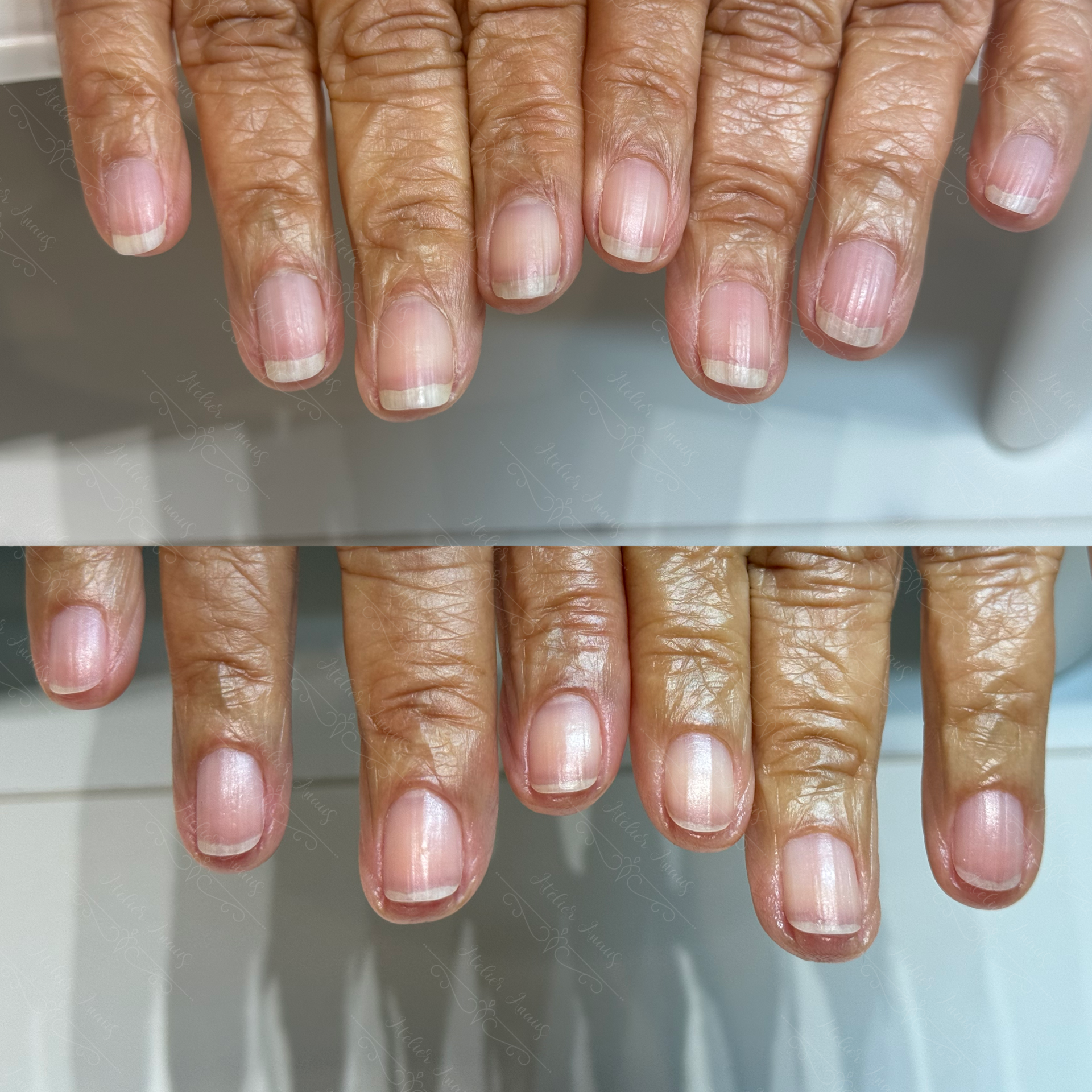
Appointment to appointment, we maintain the health and beauty of this eighty-five year old client’s nails.
Table of Contents
Age-Related Nail Changes
Stop Causing More Damage
Why Nail Care Matters Even More As We Age
A Living Record of The Past
A lovely woman named Audrey, who has more fire and spunk than her petite figure or glasses would ever give away, has been a client with us for more than a decade. Now eighty-five years old, she’s made a routine of showing up five minutes before every appointment, every four weeks, starting with us long before we had a space to call our own.
Audrey’s nails are a rarity in a world where older adults are increasingly affected by nail damage that disrupts their lives. Her nails are so strong, healthy, and beautiful that the sound of them being clipped echoes through our high ceilings as if they were tap shoes. But it isn’t just the fact that her nails are strong and healthy at her age that makes them a rarity. It’s the fact that they weren’t always this way.
If you’re younger than forty or never struggled with nail damage, you might not have given much thought to nail health before. But if you’re of a certain age or have long fought to recover from existing nail damage, you know that you’ve thought about this question more than once:
Is it too late to recover from nail damage?
Even though she began working with us in her seventies, Audrey had asked herself this question hundreds of times in the years before. At that point, she had been getting manicures with regular polish most of her life, and the toxins from the regular polish had soaked through her natural nails, compromising her keratin layers and discoloring them. They were flimsy, broke often, and unflatteringly yellow. She wanted to try something new but the nail salons she visited were no help and the amount of information online was overwhelming. Nonetheless, she kept switching salons until she found us by chance, when we were working for a local place here in Philadelphia.
In the ten years since then, we’ve transformed her nails. Her nails today are strong, never break, and are a beautiful pink shade. We accomplished this in her eighties. So together, we answered the question: It wasn’t too late for Audrey to recover from nail damage.
That being said, every case of nail damage has unique circumstances and requires its own analysis. And the changes that aging brings about to our nails are very real.
Age-Related Nail Changes
The shift in mindset post-nail damage is similar to what happens when you become injured or sick: one moment you pay absolutely no mind to your health, and then the next, that’s all you can think about. As we grow older, even if our nails aren’t bothering us, we’re vaguely aware that our bodies are undergoing change. We know intuitively that the status of our health is as precious and precarious as it’s ever been.
Through our ongoing, years-long relationship with older clients, we’ve observed with our own eyes that one of the biggest changes that comes with age is that the rate of nail growth slows. This isn’t something to scoff at: Consider that in healthy young adults, the average rate of growth for fingernails is less than three millimeters per month. Even with youth on our side, our nails grow less than the size of a pea, much less an M&M.
This matters because nail damage can’t be healed in place, unlike injuries to our skin or bones. Our nail plates lack nerves and blood vessels, and are in fact, dead: they are made up of dead, compacted keratin cells. Nail rehabilitation follows this cycle:
New nail material emerges from the nail matrix, pushing the existing nail damage towards the nail tips, where eventually the damaged portions can be trimmed away.
With older adults, the time it takes for existing nail damage to move to the nail tips becomes considerably longer. Which is to say that older people heal slower from nail damage. Along with this, age often ushers in noticeable changes in color, thickness, texture, and shape of the nails.
One of the most visibly noticeable changes is the increased prominence of nail ridges. Nail ridges are often treated as a nuisance and something to get rid of through excessive buffing and nail drill use, but in it of themselves, they are a natural part of aging. Frequently misunderstood, attempts to get rid of them tends to cause nail damage.
In this way, the body’s biological aging factors confuse people, throwing a monkey wrench into nail rehabilitation that likely would have been more straightforward and healed much quicker when you were younger.
This leads to a saying we often tell our clients: It’s better to prepare and prevent, than to repair and repent.
Like it or not, aging is an undeniable fact of being human. Rather than burying our heads in the sand trying to deny this, the Atelier Anaiis nail care system works with it.
Our devoting significant time to the treatment of the skin surrounding the nails and shielding the nails through protective gel serves a very specific purpose. It shepherds damaged nails back to health through the inevitable changes brought forth by time, and helps prevent nail damage that will be more cumbersome to recover from when you’re older.
To circle back to our client Audrey, we’re reminded of what she said after three years, when we’d officially completed the rehabilitation process:
“Why didn’t I find you sooner? I could have saved myself so much pain and suffering.”
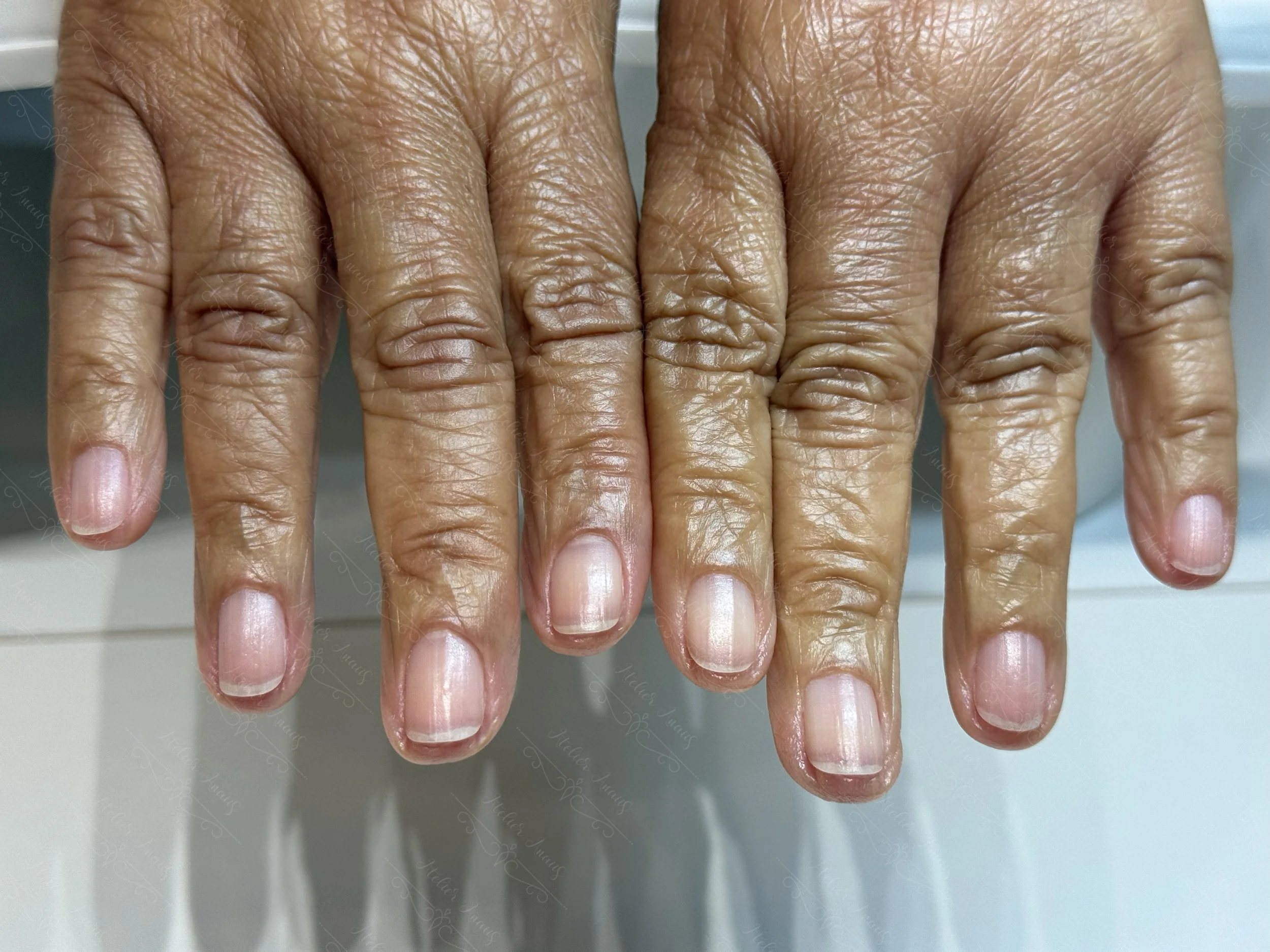
Our eighty-five years old client’s beautiful, healthy nails.
Stop Causing More Damage
A non-negotiable part of healing nails is this: In order for the body to recover from the damage it has sustained, you first have to stop the behavior causing the damage.
This sounds obvious in the context of other things. If someone has liver damage, they have to stop drinking. If a smoker is discovered to have lung cancer (and they’re determined to beat it), they know inherently that they’ve already smoked their last cigarette. And yet this same idea continues to elude many people when it comes to their nails.
In the previous section, we discussed the languid nature of nail growth. Unfortunately, this means that the very limited amount of healthy growth you have will never outpace the rate at which nail damage occurs. This is because in stark contrast to nail growth, nail damage often happens at the blink of an eye.
Consider rings of fire caused by nail drills. While you may not notice them for many months, the reality is that a split second of the tiniest amount of added pressure (often unnoticed by you or the nail tech) can make the drill bit go too far, burrowing deep into your keratin layers. Then, appointment after appointment, the grooves become more pronounced. This is the unfortunate situation that some of you find yourselves in, which is that your keratin layers have been repeatedly disrupted for a long time without your knowledge.
We also see this with nail biters and nail pickers who take chunks out of their nail tips at a time. The damage happens in an instant, but to grow out those damaged keratin layers? It’ll take months, and in the meantime, if you don’t stop biting or picking, damage will continue to accumulate.
Through our work, we’ve observed a compounding effect where the weakening of one aspect of the nail leads to a different kind of nail damage. For example, thin nails are often plagued by splitting and breakage, while yellow nails can easily peel. Bitten nails are always accompanied by cracked, jagged nail walls and a plethora of hangnails.
It’s this combination of the compounding nature of nail damage with the naturally slow growth rate that makes nails so tricky to heal.
This is why it’s imperative to address the damage-causing behavior before recovery begins. Without stopping damage first, you’ll be stuck fighting an uphill battle: Your rate of growth and recovery will always be slower than the rate at which nail damage accumulates.
Why Nail Care Matters Even More As We Age
In exercise science, it's often said that the older you become, the more protein you should consume. The reason is a phenomenon known as anabolic resistance: as we age, our muscles typically becomes less responsive to the muscle-building effects of amino acids from protein in food. Yet this recommendation runs counter to what often happens in real life: Many older adults experience declining appetites and eat less, not more.
There's an important lesson here that goes beyond muscle.
As we age, taking care of our bodies doesn't become less important. In so many ways, it becomes more important precisely because we're getting older.
Our nails are no exception. As we’ve seen, aging gradually slows nail growth, meaning that damaged portions of the nail plate take longer to grow out and be replaced by new nail. Changes in the nail plate and surrounding skin can also make maintaining healthy nails more challenging.
And yet, many of the practices we associate with conventional manicures—aggressive buffing, repeated use of nail drills, and a complete disregard for the surrounding skin—continue to prioritize superficial appearance over long-term health.
If nail damage takes longer to grow out as we age, shouldn't preventing that damage become an even greater priority?
That's why we believe nail care matters more, not less, as we grow older. The goal isn't to fight aging or chase the appearance of younger nails. It's to preserve what we have, protect what continues to grow, and give our nails the best opportunity to remain healthy throughout our lives.
A Living Record of The Past
If you’re reading this, we know that your nails matter to you. Having beautiful nails makes you feel put together, and you want them to be as healthy as possible, just like with the rest of your body.
Unfortunately, we live in a time when this seemingly simple combination of desires often feels impossible to actually have. Nail damage through months of electric nail drill use, careless product removal, and continued nail biting and nail picking behaviors continue to run rampant, affecting more and more people every day.
But the worst consequence of all of this nail damage is that you can come to believe that your nails will always be defined by it. After all, like the rest of your body, nails are a record of the past: A reflection of the accumulated effects of genetics, development, behavior, environment, and past experiences.
While we have to acknowledge that there are certain genetic and developmental factors we cannot change, we’ve seen together with our clients that biological history can be reversed through carefully considered nail care.
It doesn’t have to be too late to recover from nail damage.
Audrey is living proof of that.