Brittle Nails and Nail Ridge Recovery Over Six Months
This client came to Atelier Anaiis with brittle nails, pronounced nail ridges, and visible signs of long-term structural weakness. Through restorative nail care and protective gel care, we focused on supporting healthier nail growth while protecting the natural nails from everyday stress.
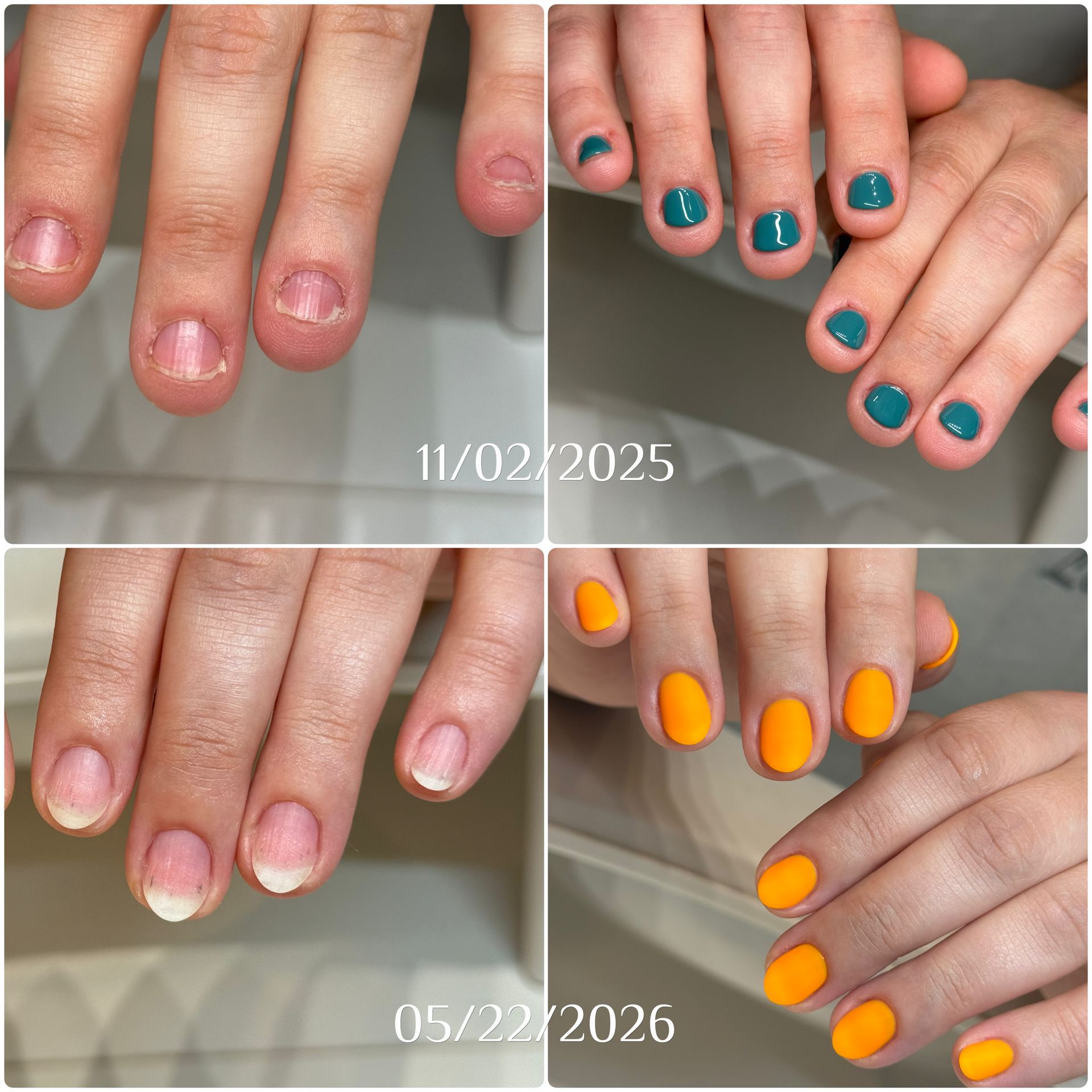
Before and after protective gel care over six months.
When this client first submitted her intake form, she talked about having brittle nails and having poor nail care habits. The photo she attached of her nails certainly confirmed those traits. But that wasn’t the entire story — once we examined her hands in person for the first time, we discovered that she also had a habit of biting and picking her nails.
This is surprisingly common and helps illustrate a point — that nail health is not just physical, but emotional, particularly with nail biting and nail picking, which come wrapped in swaths of shame and embarrassment. Many women attempt to downplay the consequences of the behaviors or worse, continue to visit conventional nail salons for manicures that further damage their nails in an effort to cover-up and distract from thin, brittle, and damaged nails.
At Atelier Anaiis, we work with hard-to-discuss nail topics every day. Because this particular case has more attributes that are in line with thin, damaged nails than the more extreme cases of nail biting and nail picking that we treat, the following discussion will be focused on how we treated brittle nails and nail ridges.
Before Restorative Nail Care
“I just don't have good nail care habits. I'm trying to fix that!”
“I’m hoping for less brittle nails and healthy cuticles.”
— The client, in her own words.
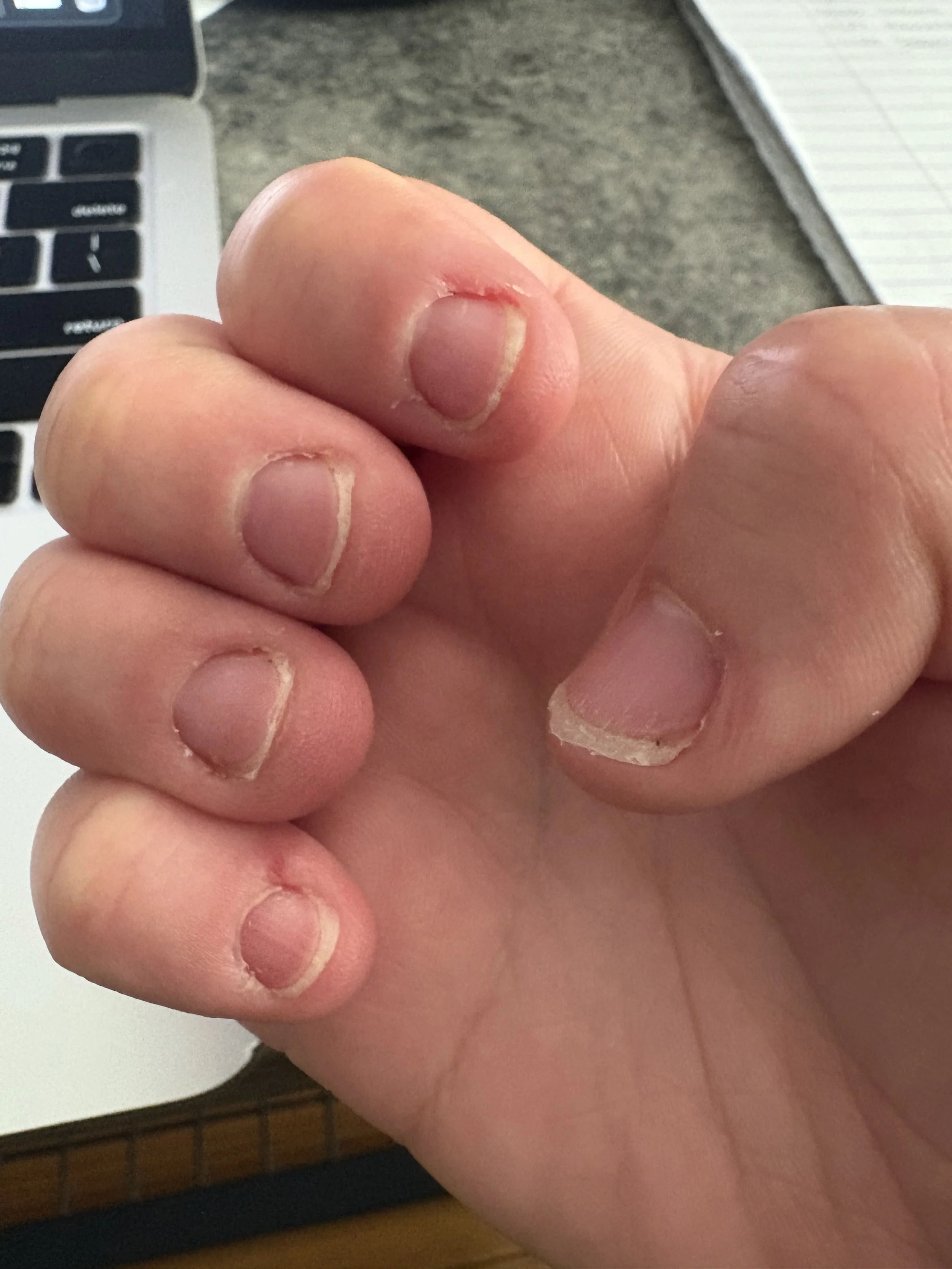
The client’s nails before becoming a client at Atelier Anaiis.
“I just don’t have good nail care habits.”
Most of the clients we work with have good intentions for their nails even before they come to us. But this client is a living example that all the good intentions in the world won’t help solve nail issues if the chosen remedy is fundamentally misaligned with your particular needs.
While Atelier Anaiis teaches general “good nail care habits” through our numerous educational articles, the benefit of becoming a client is the preparation and hands-on guidance through a customized restorative nail care plan created for your particular nail needs. And what we noticed first with this client was not her actual nails, but the dry conditions of the skin around her nail plate, or her nail walls. In the photo above, sent to us as part of her intake form, you can see the pink swelling of the damaged skin, the aftermath of a painful hangnail on both her index and pinky fingers.
“Good nail care habits” should address areas that are most lacking in the maintenance of nail health, and that’s unique for every client. For this particular client, her nail care habits needed to revolve around actions that help restore her skin – and this is best accomplished through increasing hydration and moisturizing, which supports recovery after treatment at our nail care studio. Restorative nail care in its simplest terms is achieved through an ongoing alternating pattern of treatment, then proper aftercare at home. Lacking in hydration and moisturizing would be the focus of her aftercare, resulting in less hangnails and smoother healing.
“I’m hoping for less brittle nails and healthy cuticles.”
Transforming brittle nails into healthy, strong nails is a particular speciality for Atelier Anaiis, anchored by hands-only techniques that banish electric nail drills, one of the leading causes of brittle nails. This approach is the bedrock of our philosophy on nail health, as consequences of electric nail drill use like brittle nails have even more negative downstream effects like the short nail plates this client initially arrived with.
While the angle of the hand in the photo above certainly accentuates the shortness of the nails, it helps illustrate a point – at Atelier Anaiis, the size and length of natural nails is a telling part of the evaluation of how healthy the nails are. Put simply, seeing diminished nail plates (not just “keeping nails short”) tells us that the nails are not healthy enough to support length.
In this way, maintaining the length of nails becomes not just about aesthetics, but a nail health marker.
The Protective Gel Care Process
One of the biggest misconceptions about restoring thin, brittle nails is that to grow healthy nails once again, you should keep your nails bare. While maintaining bare nails is ever-so-slightly better than continuing with acrylic, dip, or gel manicures that use the electric nail drill, the primary reason that bare nails fail as an effective remedy is because the nail plate lacks the necessary protection that gives damaged and compromised nails the time and space to begin pushing out healthier regrowth.
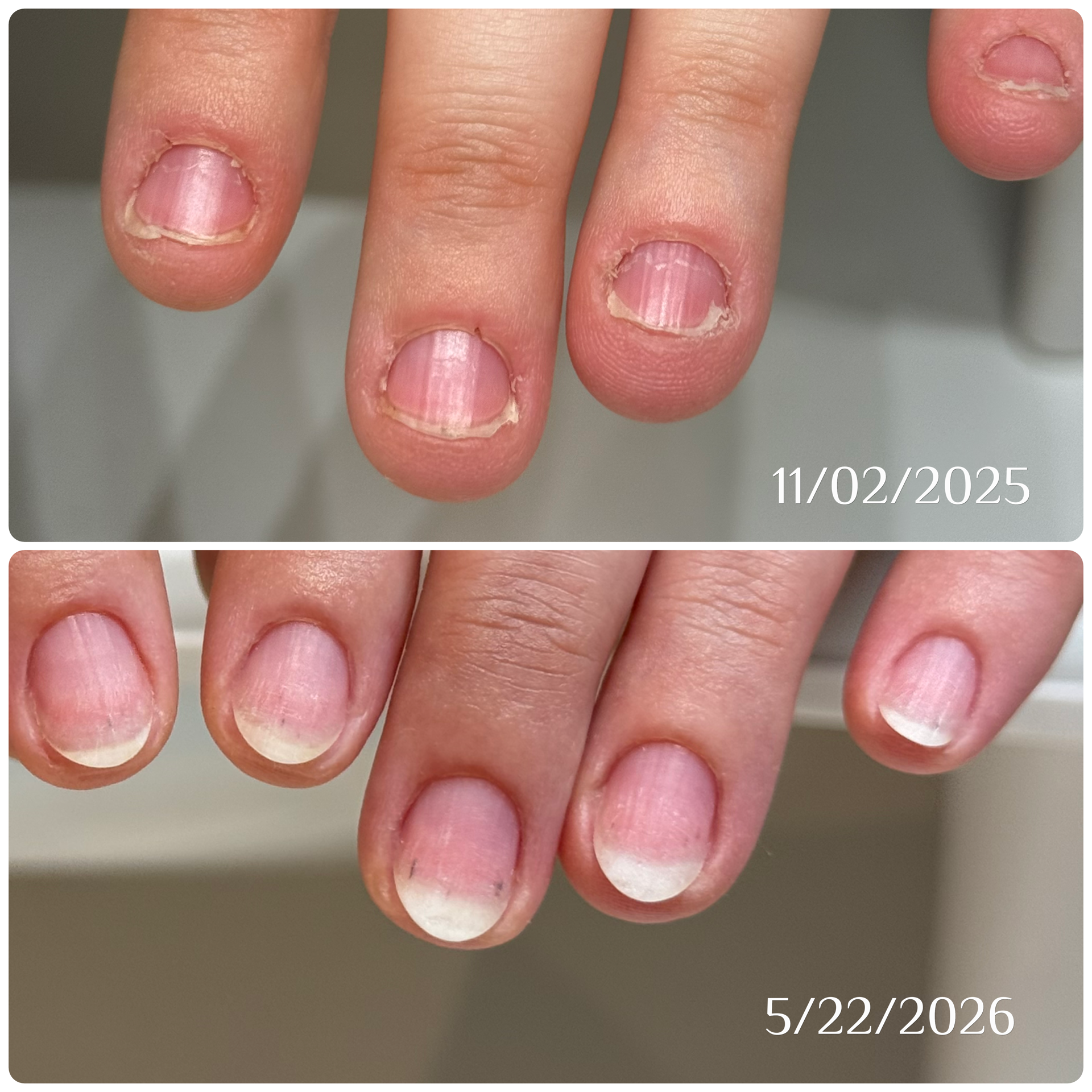
Before and after, natural nail transformation through protective gel care.
In the photo above, we can see how brittle the client’s nails really were before restorative nail care. Already very fragile to begin with, the prominent longitudinal ridging had a high likelihood for cracks, splits, and breaks to happen along those lines very easily. By keeping nails bare, you increase the risk of breakage from everyday activities that makes restoration of brittle nails and growth of healthy ones a longer road than it has to be.
Nail ridges are a natural part of the aging process, but the prominence and amount of ridging has to be kept in check, much like eating healthy fats — in moderation, they’re a needed part of many bodily functions, but too much and you’re asking for a world of trouble. With longitudinal ridges, trying to get rid of the lines completely means you’re risking having thin nails; too much ridging and they will serve as a guide for cracks and splits to occur along the lines.
This is one of the main reasons why all clients at Atelier Anaiis receive a protective gel layer. The protective gel helps keep ridging in check, as evidenced by the “After” portion of the photo above: there’s a clear reduction in nail ridges after six months of restorative nail care and no part of it involved electric nail drills or buffing aggressively.
Today, this client’s nail walls are healthy and elastic, she has very little hangnails, and her nail beds have expanded to twice the length from before, as the good nail care habits that we discussed earlier have been woven into the fabric of her daily life.
But it’s also important to discuss the obstacles the client faced, as it wasn’t a road without setbacks. Particularly after the first three appointments, spaced four weeks apart each time, there were a few instances of broken nails and peeling gel layers. This was to be expected: as brittle areas of the nail continued to be pushed out by new growth, these weak and thin keratin layers became the main part of her nail tips. Even with the protective gel layer, the free edge was vulnerable and succumbed to breaking at times during the first months.
We make this point because most women judge the results of nail services immediately. While this is fine for services prioritizing aesthetics over nail health, restorative nail care at Atelier Anaiis demands a longer time horizon of months, reflecting the average growth rate of nails: less than 3 millimeters a month.
Where Her Nails Are Today
While it would be easy for us to claim that this client’s nail restoration is all done, there’s still crucial work going on today. Her natural nails have finally grown past her hyponychium — the seal underneath the nail tips that serves as a barrier from debris, bacteria, and water — which were severely damaged and detached as a result of her nail biting and nail picking. The nail length is a requirement for the hyponychium to reattach itself naturally.
With protective gel care, there is no true “After” – instead, the client transitions from restoration to maintenance. The reality is that brittle nails can always return if the client reverts back to neglect, nail biting, nail picking, or poor nail care habits. This is much like other, more mainstream aspects of health, like staying in shape and maintaining sobriety. To continue reaping the benefits of change requires a totally new lifestyle, and is never a one-and-done deal.
The great news for most clients is that to come to this point, the point where their nails are healthy, strong, and beautiful, required patience and work, and most importantly, they did it.
If you’re interested in recovery from brittle nails or nail ridges, begin by filling out our intake form.