Nail biting recovery is best understood through before and after changes over time, as the nail plate and surrounding skin gradually rebuild.
Table of Contents
The Story Behind Nail Biting: Years of Coping
"It's Embarrassing." The Emotional Burden of Nail Biting
When You've Tried Everything — and Still Struggle
If You Bite Your Nails, You Belong Here
Nail Biting Recovery: Before and After
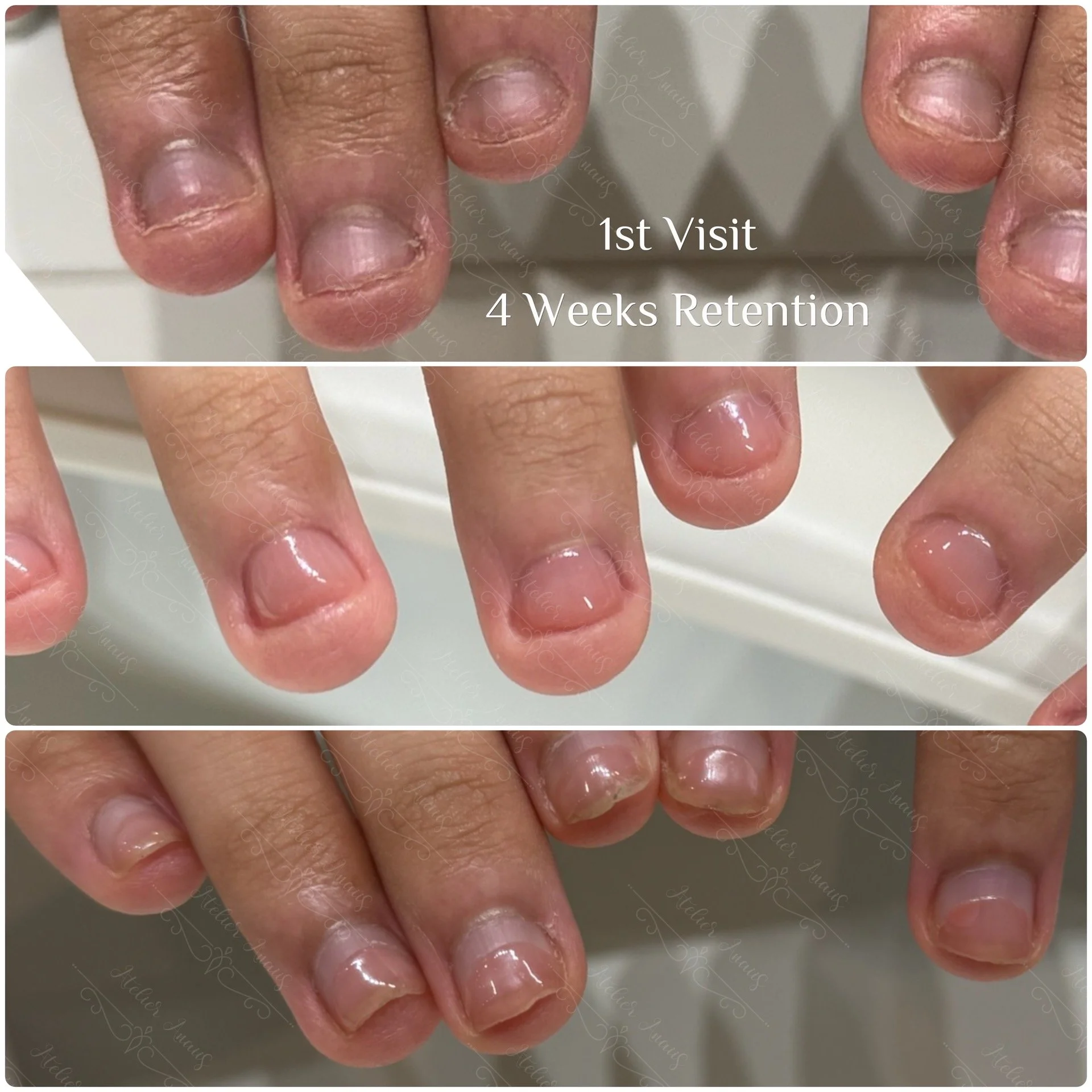
The collage above combines three photos of a nail biting recovery client at Atelier Anaiis.
Top: The true “Before” photo, taken at the client’s very first appointment. The hyponychium has detached, there is an overgrowth of the eponychium at the origin of the nails, and lots of hangnails from biting.
Middle: Taken “After” the very first appointment. The client’s eponychium has been reshaped, damaged skin removed, and nail walls treated.
Bottom: Taken at the beginning of the second appointment, four weeks later. We can already see tremendous nail growth, with the nail plate almost doubling in length, nail walls have stabilized, and there’s a distinct lack of hangnails.
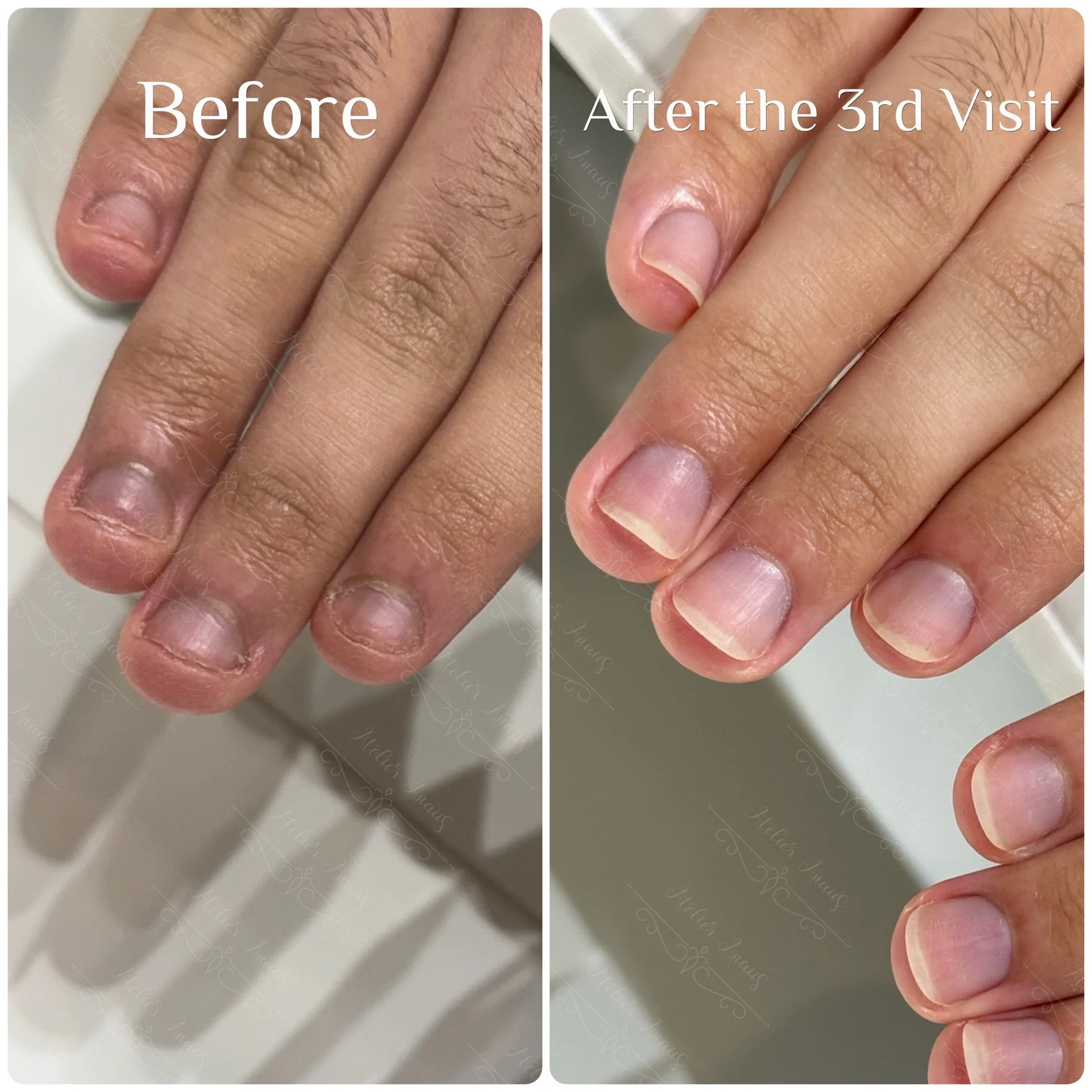
The nail biting recovery results show a stunning transformation after just three visits.
The client’s nails are unrecognizable: healthy and beautiful color, no hangnails, nail length tripled, and no overgrowth of the eponychium.
From here, we focus on strengthening the nails.
For many women who struggle with nail biting, the hardest part isn’t always the physical damage.
It’s the isolation — the feeling that everyone else has figured out nail care except you.
At Atelier Anaiis, women reach out to us every day hoping for help with nail biting recovery. And the stories they share with us are more similar than they realize.
The shame, the embarrassment, the fear of being judged. These threads appear again and again, connecting the lives of people who’ve spent years hiding their hands.
This post is for anyone who bites their nails and wonders whether they’re the only one struggling.
You’re not. Not even close.
Below, we’re sharing real, anonymous excerpts from our clients’ intake forms — women who asked Philadelphia’s home for nail biting recovery if healing was possible.
Their stories show the emotional weight of nail biting, the years of trying to stop, and the desire to finally feel at peace with their hands.
These are the women who chose recovery.
These are the women who sit across from us today, growing stronger nails — and a stronger sense of self — one appointment at a time.
The Story Behind Nail Biting: Years of Coping
So many clients come to us believing their nails are uniquely damaged — that we’ve never seen anything like them. But their journeys share the same quiet thread: years of temporary fixes.
One client wrote:
“I used to bite my nails/pick at cuticles for years. I've been getting them done with dip, acrylic, or gel X for 2–3 years now so no more biting. But when I don't have anything on them they're VERY thin, easily bend and rip off, and I have some yellowing.”
This story is all too common.
Women try acrylic, dip, gel x — anything to stop biting.
These different manicures might pause the habit, but it turns out that they leave the nails even thinner and feeling worse than before.
Why? Because nail drills – used in most nail salons – actively damage your nails and surrounding skin.
This means that there’s a strong possibility that not all the nail damage you have is from your nail biting habit.
It means that most nail salons are making your nails even worse.
It’s keeping you stuck in a vicious cycle of coping, but not actually solving the problem.
"It's Embarrassing." The Emotional Burden of Nail Biting
Many of the women seeking nail biting recovery at Atelier Anaiis write that they feel embarrassed or ashamed of their nails.
That’s a heavy emotional burden to carry.
One client shared:
“I have really badly damaged nails and cuticles due to biting and poor habits. It’s really embarrassing and I want it to get taken care of. Again I’m so sorry they’re really damaged and totally understand if it’s not possible to handle.”
Women apologize for the state of their own hands — even though their nails tell a story of simply doing their best trying to get through life.
Women who bite their nails often fear judgment. And they expect us to confirm the worst: that their nails are beyond saving.
Instead, we remind them:
Your nails are not a burden.
They are not too far gone.
And you never have to apologize for walking into our restorative space, designed to help you heal.
The emotional relief that comes from being seen, not judged, is often the first breakthrough in nail biting recovery.
When You've Tried Everything — and Still Struggle
Most women try at-home remedies or common nail salon manicures before they come to us.
Whether it’s getting manicures often (a strategy with its own problems), trying non-toxic bitter polish, lathering their hands in cuticle oil (another one with its own problems), or hand creams, consistency can only help to a certain point.
As one client wrote:
“Brittle and weak nails. Small nail beds. Been struggling with nail biting for a while… Taking good care of them consistently helped grow them long but they were still weak without a nail polish base.”
Moments like this are when you might feel defeated.
Because even though you do all the supposedly “right” things — oils, creams, frequent manicures (this last one is really a bad thing) — your nails still lack the look and feeling you seek.
Nail biting changes the biology of your nail plate and surrounding skin.
That’s why nail biting recovery requires structure, not strengthener.
At Atelier Anaiis, we rebuild from the foundation up:
Restoring the nail folds and the eponychium
Gently removing damaged skin
Creating a long-lasting protective structure through gel
Allowing your nails to grow consistently and undisturbed
Through our care, women who used to think that their weak nails were “because of genetics” learn that their nails can be strong, beautiful, and long.
If You Bite Your Nails, You Belong Here
Every nail biter who comes to our nail care studio shares the same hope:
“I just want healthy nails. I want to feel confident. I want to stop hiding my hands.”
You’re not alone in that desire.
And you’re not alone in your struggle.
Whether you’ve been biting since childhood or only in stressful seasons; feel shame and embarrassment about your hands; feel defeated from a lack of progress.
You belong here.
Nail biting recovery is not about perfection.
It’s about restoration — of your nails, your confidence, and the way you feel when you look at your hands.
If you’re ready to begin your own quiet, steady recovery journey, our team at Atelier Anaiis is here to walk with you.
One appointment at a time.
Frequently Asked Questions
Q. Are my nails too damaged to recover from nail biting?
No. Many women arrive believing their nails are uniquely damaged or beyond repair—but this is rarely true. Nail biting alters the nail plate and surrounding skin, but with the right care, nails can be rebuilt. Recovery requires structure, consistency, and protection—not quick fixes.
Q. Why did my nails feel worse after acrylic, dip, or gel X?
Because most manicure services rely on nail drills, which thin the nail plate and damage the surrounding skin over time. While these services may temporarily stop biting, they often worsen nail health underneath—creating a cycle where nails feel weaker once the product is removed.
Q. Is all of my nail damage really from nail biting?
Not necessarily. Many clients discover that a significant portion of their damage came from repeated salon services, aggressive prep, and improper removal—not just the biting itself. Nail drills are a leading contributor to nail thinning, yellowing, and sensitivity.
Q. Why don’t oils, creams, and nail strengtheners fix nail biting damage?
At-home care helps, but only up to a point. Nail biting changes the biology of the nail and surrounding structures, meaning surface treatments alone cannot restore strength. Healing requires rebuilding the foundation of the nail—especially the nail folds, eponychium, and protective structure.
Q. Why are frequent manicures not recommended for nail biting recovery?
Too-frequent manicures often involve repeated removal and re-preparation, which further disrupts the nail plate. Recovery depends on allowing nails to grow undisturbed within a protective structure, rather than constantly being reset.